Sewer Camera Inspection
Essential on laterals long enough that guessing is genuinely expensive.
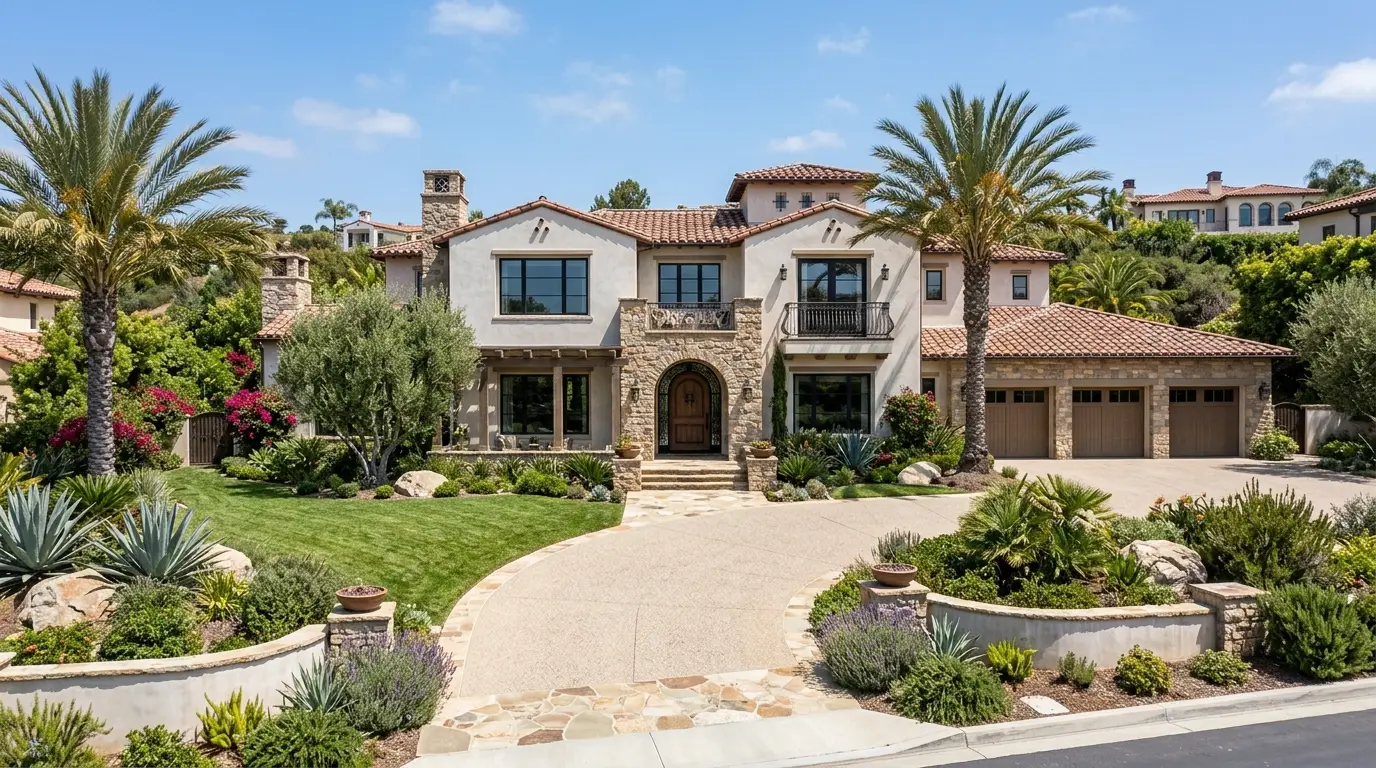
North Tustin is unincorporated county territory with custom homes on generous lots. That changes almost everything: laterals run a hundred feet or more before they reach the main, pressure varies with elevation, and no two houses share a build spec.
Lot size and elevation change the answer, tell us both.
On a standard suburban lot the private lateral is twenty or thirty feet. In North Tustin it can be well over a hundred, often crossing changes in grade, mature root systems and hardscape that was expensive to install. Every foot of that is the homeowner’s responsibility, and every foot is a place a problem can start.
Long runs also mean the diagnostic work is more valuable, not less. Cabling a hundred-and-forty-foot lateral without a camera is working blind across a distance where the fault could be almost anywhere. Locating precisely (depth, distance and offset) turns a speculative excavation into a targeted one, and on lots with this kind of landscaping the difference is substantial.
Elevation is the other variable. Properties on the higher ground can sit at the weak end of the supply, sometimes with a booster in the mix; properties lower down can run high enough to need serious regulation. Neither is a problem in itself. Both are a problem when the equipment managing them has quietly failed.
On a long run, small persistent losses add up faster than anyone expects.
Locating precisely is worth more here than anywhere else in Tustin.
Some North Tustin properties connect to sewer, some historically did not, and a few still have legacy infrastructure in the ground from either era. Before recommending anything we establish what is actually there rather than what the county map suggests. Where a lateral crosses a neighbouring parcel or an easement (which happens on lots of this shape) that affects both method and permission, and it is better established at the diagnosis stage than mid-excavation.
Large properties usually have large irrigation systems, and the interaction between irrigation demand and household supply is a recurring source of complaints that get blamed on the wrong thing. A pressure log across a full irrigation cycle tells you whether you have a supply problem, a regulator problem or simply a scheduling problem. Where a booster is installed, its condition and settings matter more than most homeowners realise.
Custom homes have custom plumbing: manifold systems, multiple heaters, recirculation loops, sometimes a well or a legacy line nobody documented. There is no standard layout to fall back on, which means the first job on an unfamiliar property is understanding it. We would rather spend the first hour mapping than the third hour surprised.
On a custom property, understanding it is most of the work.
Weighted toward diagnosis and long-run infrastructure rather than fixture swaps.
Essential on laterals long enough that guessing is genuinely expensive.
Protects mature landscaping and hardscape across long runs.
Long private supply lines fail at joints and under grade changes.
Elevation-driven pressure needs equipment that is actually working.
Finds losses on runs too long to inspect by eye.
Custom builds age unevenly; some sections go long before others.
Because the area sits outside the city boundary, anything requiring a permit is an Orange County matter, and county scheduling runs to its own calendar. That is worth knowing before you plan a job around a particular week. We will tell you when something is likely to need one.
Access on these properties is usually good for a truck but long from the street to the work. Where equipment has to be brought a hundred feet across landscaping, we plan the route with you rather than driving across it and apologising afterwards.
Some properties here have private roads or shared driveways with their own arrangements. If yours does, mention it when you call, it occasionally affects when heavy equipment can come in.
For a large lot, one thorough visit beats five reactive ones.
Know your lateral route: if it has ever been cameraed or located, keep the report. It is the single most useful document a large-lot owner can have.
Watch the irrigation interaction: test household pressure during a full irrigation cycle, not just at rest. That is where the real number is.
Check for wet ground in dry weather: on a long run, a supply leak often shows at the surface before it shows on the bill.
The unincorporated hillside communities either side.
Generally at the point of connection to the public main, which on a large lot can be a very long way from the house. Everything between the building and that point is private. Because the runs here are so long, that boundary carries more financial weight than it does on a standard suburban lot, and it is worth knowing exactly where yours sits before there is a problem.
Usually not. It is more often a supply capacity issue, a regulator that cannot keep up, or simply an irrigation schedule that overlaps with household demand. A pressure log across a full cycle separates those causes cleanly. We would test before recommending any equipment.
North Tustin is unincorporated, so it is Orange County rather than the City of Tustin. The practical difference is process and timeline rather than what is allowed. We flag when work is likely to need a permit; we do not present ourselves as the authority on county requirements.
Often yes, and long runs are exactly where it earns its cost, the alternative is a hundred feet of open trench through landscaping that took twenty years to establish. Whether your specific line is a candidate depends on its condition and continuity, which the camera establishes first.
Frequent cycling usually means either a waterlogged tank, a pressure switch out of adjustment, or demand that has grown past what the system was set up for. All three are diagnosable in a single visit and none of them require replacing the pump as a first move.
It is common on custom builds and it is manageable. It means the first visit includes mapping, locating shutoffs, tracing runs, confirming what feeds what. That time is not wasted; it makes every subsequent job faster and cheaper, and you keep the information.
No two North Tustin houses are the same. Neither are the answers.
Long laterals, elevation, irrigation and one-off systems. Tell us what the property is and what it is doing.
(714) 598-4492A person answers, any hour, holidays included.