Hot-side pinholes
The single most common find. Hot copper in or under concrete, thinned by hard water and pressure, leaking continuously into sub-grade.
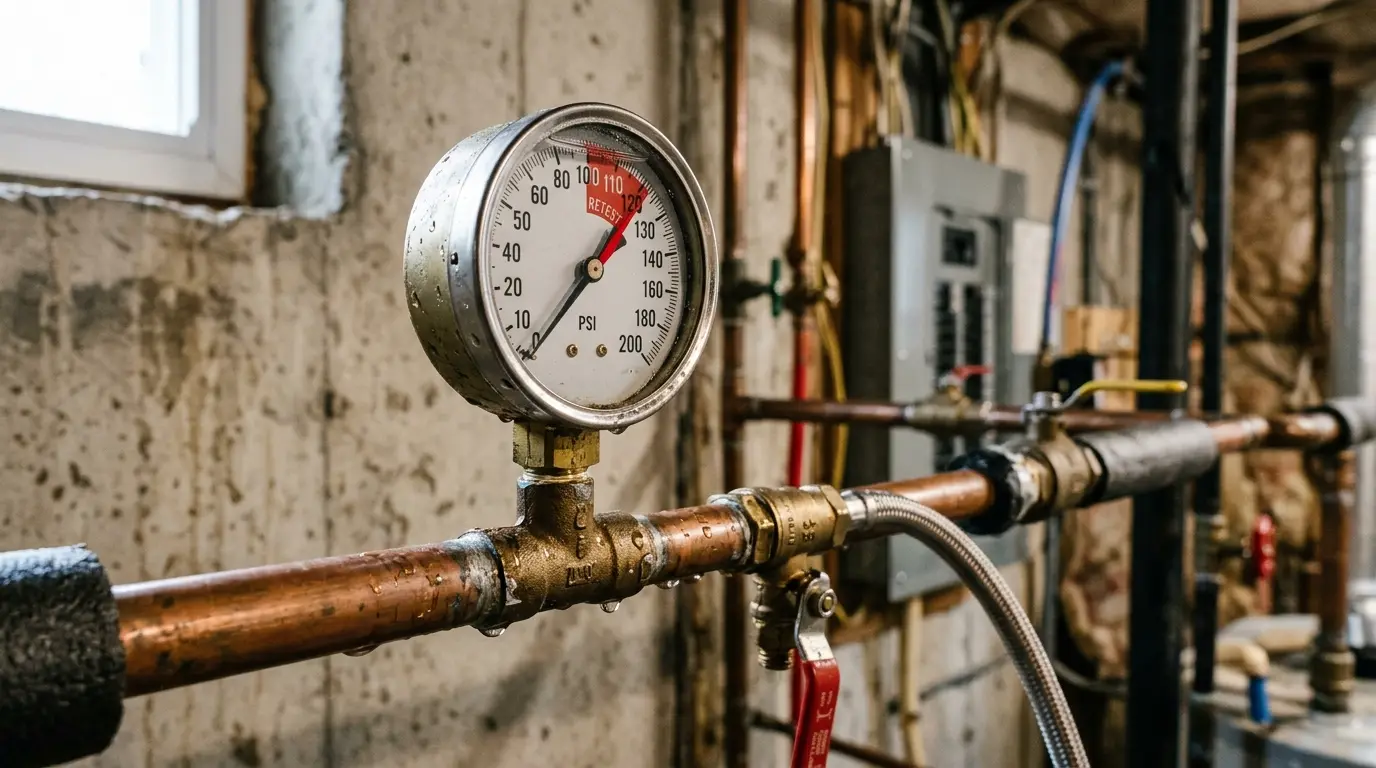
Something is leaking and nobody can see it. Acoustic listening, pressure isolation and thermal imaging narrow it to a spot on a wall or floor, so the repair is one clean opening instead of a search.
Bring your last two water bills to the call, the jump size is diagnostic.
Water is a liar. It appears at the lowest point it can reach, which is frequently nowhere near where it left the pipe. A stain on a hallway ceiling can come from a shower valve two rooms away, travelling along a top plate until it finds a gap. Cutting into the stain finds wet drywall and no pipe.
Detection is the discipline of narrowing that down before anything is opened. Isolate sections of the system and watch pressure decay to establish which line is losing water. Listen acoustically, because pressurised water escaping through a small hole makes a specific noise that carries through pipe and structure. Read temperature differentials where a hot line is involved. Trace the line electronically so you know what is actually behind the wall.
Done well, the output is a mark on a surface and a sentence: the hot line feeding the master bath is losing pressure, and the loudest point is here, roughly eighteen inches below the valve. That is a repair. Without it, you get exploratory demolition and a bill for guessing.
You do not need all of these. Any one that persists is enough.
A locate costs a fraction of what opening the wrong wall costs.
Tell us what you can hear and where it is wettest.
Certain leaks repeat across this city because certain construction details repeat. Slab-on-grade tract housing hides hot-water lines under concrete. Older Old Town properties hide galvanized in lath and plaster. Newer developments run manifold systems through attics, where a single fitting drips onto a ceiling for months before it shows.
Outdoors is the other half of the work. Irrigation systems fail at valves and buried laterals, and because the ground is already meant to be wet, nobody notices until a bill arrives. Pool plumbing does the same thing. We test those separately from the house so the reading actually means something.
The single most common find. Hot copper in or under concrete, thinned by hard water and pressure, leaking continuously into sub-grade.
Old valve bodies and failed solder joints behind tile. Shows up two rooms away on a ceiling, which is why locating matters.
Attic-mounted heaters and manifold fittings drip quietly onto insulation until the ceiling below stains or sags.
Buried laterals, valve bodies and the service line between meter and house. Often the answer when the inside of the house is bone dry.
Roughly an hour to two hours, in this sequence.
Read the meter with the house shut down to quantify the loss, and look at the bill history to see when it started. This separates a new failure from something that has been running for a year.
Close off the water heater, the irrigation, the pool fill and individual branches in turn, watching what the meter and pressure gauge do. This is what tells us which system is losing water before we look for where.
Ground microphones and pipe-contact listening across the suspect run, working the sound to its loudest point. Where relevant, thermal imaging and line tracing confirm what the acoustics suggest.
The spot gets marked, and you get told what was found, how confident it is, and what the repair involves. If insurance is in play, we put the finding in writing.
Most locates are done inside a single appointment.
Most jobs use two or three of these together. Any single method on its own has blind spots.
Sections closed off and pressurised, watching decay over time. Establishes which line is failing and roughly how badly, with no equipment near the leak itself.
Trade-off: Tells you the line, not the spot. Always the first step, never the last.
Amplified listening for the sound of escaping water through slab, soil and structure. The workhorse for pressurised leaks under concrete.
Trade-off: Needs a quiet house and pressurised pipe. Not useful on a drain leak that only runs when a fixture runs.
Surface temperature mapping to trace hot lines and see moisture spread. Very good at confirming an acoustic find and showing how far water has travelled.
Trade-off: Reads surfaces, not depth. Excellent confirmation, poor as a sole method.
A camera down drain and sewer lines, and electronic tracing to map where a buried line actually runs versus where the plans say.
Trade-off: The right tool for drains and laterals; irrelevant for a pressurised pinhole.
Detection is quoted flat, before the visit, based on what you describe. That matters: an hourly search creates an incentive nobody wants. You should know the number before anyone opens a van door.
The economics are simple. A locate is a small fixed cost. Opening the wrong wall is drywall, tile, paint and a day of somebody time, and you still have not found the leak. On a slab, the difference between a precise locate and a rough one can be several feet of concrete.
Flat, quoted before we arrive. No hourly search.
The meter test. Close every fixture and appliance. Photograph the meter. Wait one hour and photograph again. Any movement means water is escaping.
The water heater test. Close the cold inlet on the heater and repeat. If the meter stops, the leak is on the hot side. If it keeps going, look at cold lines and outside.
The irrigation test. Close the irrigation valve and watch again. A surprising share of mystery bills end here.
Write down what you hear. Time of day, which room, whether it changes when a tap runs. Detail on the phone shortens the visit.
What a locate usually turns into, and where we do it.
The location work is. Acoustic listening, pressure testing, thermal imaging and line tracing all happen from the outside of the structure. Opening up only happens once we know where, and then only where the repair needs to happen.
On a pressurised line under a slab, a good acoustic locate typically gets within a foot or so. That is close enough to make a small opening. Drain leaks and intermittent leaks are harder, and we will tell you honestly when a result is a strong indication rather than a pinpoint.
Occasionally the answer sits outside plumbing, a roof penetration, a window flashing, condensation from ductwork. When that happens we tell you what it is and which trade to call. You still get the answer you paid for.
Yes. Both get isolated and tested separately from the house, which is often how a mystery bill gets solved. Pool plumbing and buried irrigation laterals are common finds and easy to miss if you only test indoors.
Yes. A written description of the testing done, what was found and where, plus photographs. That is generally what a carrier asks for when access costs are being claimed.
It is the normal case, not the exception. A leak between the meter and the house, or under a slab, can run for months without a visible sign because the water goes straight into soil or sub-grade. The meter test is the reliable indicator, not what you can see.
Sometimes a two-minute call rules out a leak entirely.
One appointment, a marked spot and a written finding, then a repair that opens the right place first time.
(714) 598-4492The plumber we send gives you a firm price before work starts, and stands behind their own workmanship.