Root intrusion
Fine root mass at clay joints. The footage shows how many joints are involved, which is what decides between a spot repair and lining.
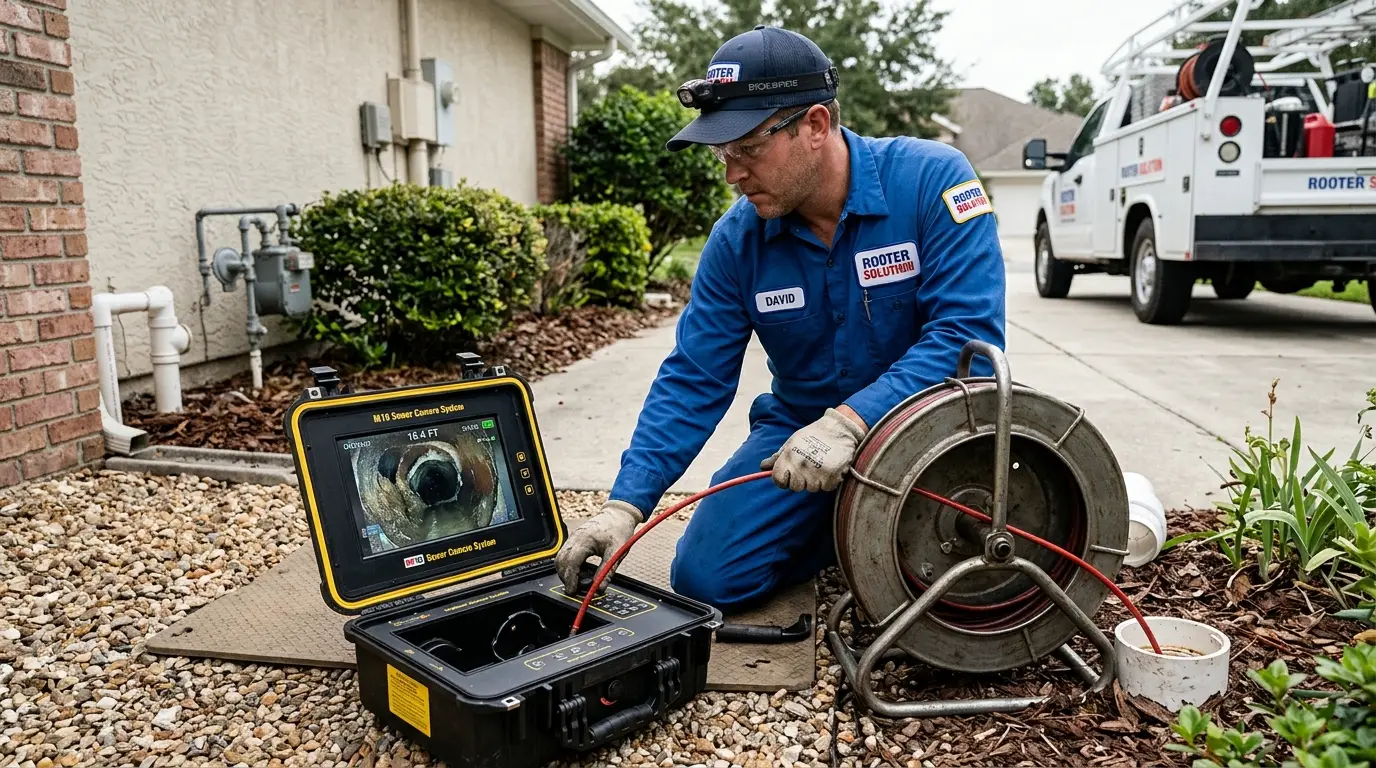
A recorded run down your lateral from cleanout to main, with each defect noted by distance and depth. The cheapest way to stop guessing what a sewer repair should cost.
Buying a house? Mention the closing date and we will work to it.
A sewer lateral is buried, gravity-fed and completely invisible from the surface. Every other way of assessing it is inference: blockage history, symptoms, the age of the house, the size of the trees. A camera replaces all of that with footage and distances.
A self-levelling camera head goes in at the cleanout and runs the full length to the city connection, recording as it goes. A transmitter in the head lets a locator mark the position and depth of anything interesting on the surface above. The output is a video, a set of measurements and a list: root intrusion at eleven feet, offset joint at twenty-six, standing water from thirty-one to thirty-eight.
That list is what makes quotes comparable. Once you know the defect and its depth, three contractors are pricing the same job instead of three different guesses. It is also what stops you paying for a trench when a spot repair would do, or a liner where the pipe has a belly.
Any one of these is enough. The pre-purchase one is the most valuable.
Against the cost of a sewer repair, or a house, an inspection is a rounding error.
Most inspections take under an hour on site.
Findings sort neatly by neighbourhood era. Older parts of the city run clay, jointed every few feet, under mature trees, root intrusion is the headline finding. Mid-century tract housing runs cast iron indoors transitioning to clay outside, and the transition point is a frequent defect. Newer developments run plastic, where the failures are almost always installation-related rather than material fatigue.
Roughly speaking, half of what we find is roots, and the rest divides between alignment problems, corrosion and standing water from poor fall. What matters is that these need different repairs, and none of them can be distinguished from a backed-up toilet.
Fine root mass at clay joints. The footage shows how many joints are involved, which is what decides between a spot repair and lining.
Sections shifted out of line by soil movement. Visible immediately on camera as a lip or a gap in the bore.
A pool of water partway along means a bellied section. This is the finding that rules out lining, and the reason to camera before buying a liner.
Rough, restricted cast iron bore or a thinned invert. Tells you whether the pipe has years left or is near the end.
Usually under an hour on site, and you get more than a verdict.
Ideally an exterior cleanout. Where there is not one, we can often access through a pulled toilet or a roof vent, and we will tell you beforehand if installing a cleanout is the sensible investment.
A blocked or heavily fouled line has to be cleaned before the camera can run it. That gets quoted separately and honestly, an inspection of the first eight feet is worth nothing.
Camera fed to the city connection, recording the whole way, with distances called out. Defects get noted as they appear rather than reconstructed afterwards.
Anything significant gets located and marked above ground with a depth, so a future repair can be planned and priced without exploratory digging.
You get the video and a plain-language summary: what is there, how serious it is, what the realistic options are, and what we would do if it were our house.
Weekday and Saturday slots available.
An inspection is a decision tool. These are the four decisions it produces.
A sound line with minor wear. The most common outcome on a newer property, and a genuinely useful result, particularly in a purchase negotiation.
Trade-off: You paid to find out nothing is wrong. That is what peace of mind costs.
Build-up, light root hair or grease with no structural defect. Cabling or jetting restores the bore and the interval before it recurs is predictable.
Trade-off: Maintenance rather than a fix, appropriate when the pipe itself is sound.
A defined defect (one bad joint, a crack, root intrusion at a few joints) with the rest of the run in good order.
Trade-off: Real cost, but scoped precisely because the footage removed the unknowns.
Standing water, multiple offsets, collapse or an invert that has gone. The camera is what tells you this before you spend money on a liner that cannot help.
Trade-off: The biggest number, discovered before you wasted money on the wrong repair.
Inspection is a flat price, quoted before we arrive, and it is one of the smallest numbers on this site. The variable is access: if there is no usable cleanout, or the line needs clearing before a camera can pass, that is separate work and you will hear about it before we start rather than afterwards.
The savings are straightforward. A camera turns an unknown into a scope, and a scope is what stops sewer quotes ranging over an order of magnitude. In a home purchase it regularly moves the negotiation by far more than the inspection cost.
Flat price, quoted before the visit.
Insist on the footage. A verbal report is not an inspection. You should leave with video you can send to anyone.
Ask for distances. A defect at nineteen feet is actionable. A defect somewhere in the front yard is not.
Get it located and marked. Surface marks with depths are what make a repair quote real rather than a range.
In a purchase, do it early. Findings can change price, terms or your mind. Late footage is a rushed decision.
What an inspection commonly leads to.
Yes. You get the footage and a written summary of what was found and where. It is your line and your decision, and you should be able to show the evidence to anyone, another contractor, a seller, an insurer.
On any older property in this city, it is one of the highest-value few hundred dollars in the whole transaction. Sewer laterals are almost never included in a standard home inspection, and a failed lateral is a five-figure item. Findings frequently change the negotiation.
We can often access through a pulled toilet or a roof vent. If neither works well, installing a proper exterior cleanout is worth doing on its own merits, it makes every future service call cheaper and faster.
Partially. Standing water itself is the finding, it means the pipe has lost fall in that section. We note where it starts and ends, which is what tells you the length of the bellied run.
Almost certainly. Seasonal blockages usually mean roots seeking moisture, and the footage shows exactly which joints they are entering through and how far along. That determines whether you are looking at one spot repair or a full liner.
Ask when you book and you will get a straight answer for your job. What we will not do is bundle it opaquely, you should always be able to see the inspection cost separately so you are free to take the footage elsewhere.
Pre-purchase, repeat blockages or a quote you want checked.
One appointment gives you footage, distances and depths, and turns a frightening unknown into a scope you can price.
(714) 598-4492The plumber we send gives you a firm price before work starts, and stands behind their own workmanship.