Joints every few feet
A liner turns dozens of root-vulnerable joints into one continuous jointless bore. The best possible candidate for lining.
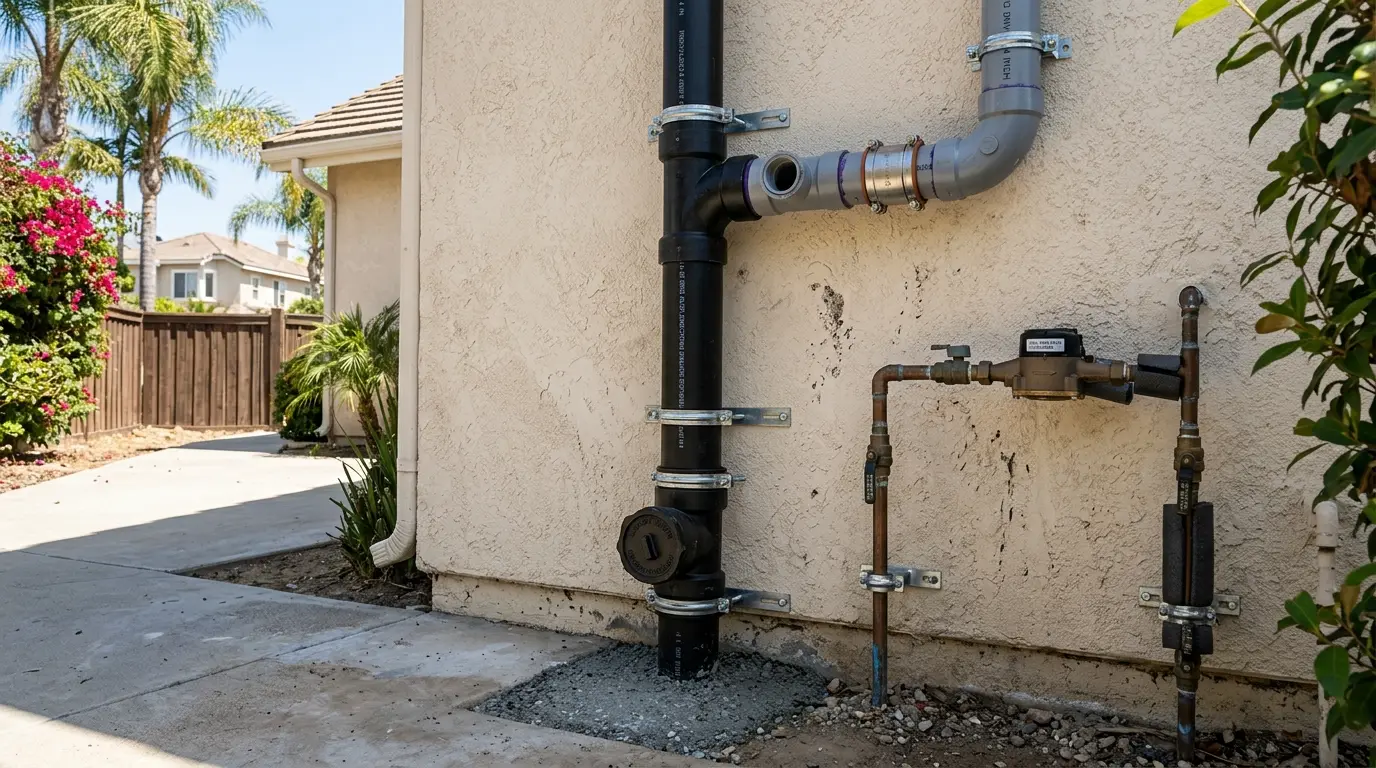
A failing lateral replaced from two small access pits instead of a trench down the length of your yard. Suitable when the camera says the pipe geometry can take it, and we tell you plainly when it cannot.
Have a camera inspection already? Tell us what it showed.
Trenchless is not one technique. It is two, and they solve different problems. Cured-in-place lining installs a resin-saturated liner inside your existing pipe and cures it into a hard, jointless pipe within a pipe. Pipe bursting pulls a new pipe along the path of the old one, fracturing the old pipe outward as it goes. Both work from small access pits at either end rather than a continuous open trench.
The appeal is obvious the moment you look at a typical Tustin front yard. The lateral usually runs under a concrete driveway, past a mature tree or two, across a lawn and out under the parkway to the street. Open-trench replacement means removing and repouring the driveway, taking out landscaping and often the tree, then restoring all of it. On many properties that restoration costs more than the plumbing.
What trenchless does not do is fix every defect. A liner follows the existing pipe, so it inherits its geometry. If a section has sagged into a belly that holds water, lining it produces a smooth new pipe with the same belly. That is the single most important thing to understand before anyone sells you a liner.
These are the situations where it usually wins.
The camera decides. Geometry, not preference, determines whether a liner will work.
Camera and locate first, that is what decides the method.
The housing pattern here plays to trenchless strengths. Post-war and 1960s–70s tract homes were built with clay or cast iron laterals running under what later became driveways, walkways and thoroughly established front gardens. The pipe is at the end of its life; the surface above it is not.
The other factor is trees. Tustin is a city of mature street and yard trees, and those trees are usually the reason the pipe failed and the reason nobody wants a trench. Lining a root-invaded clay run seals every joint the roots were entering through, without touching the root system that would be destroyed by excavation.
A liner turns dozens of root-vulnerable joints into one continuous jointless bore. The best possible candidate for lining.
Where the invert has thinned but the pipe still runs true, lining restores a smooth full-diameter bore inside it.
Access pits at each end instead of a trench through the concrete. This is usually where the cost comparison flips.
Sagged sections, severe offsets and fully collapsed runs need excavation and re-grading. A liner cannot fix slope.
Five stages. The first two decide whether the remaining three are even appropriate.
The pipe is cleaned so the camera can run the full length, and the footage is recorded. Defects, joints, offsets and any standing water get noted by distance from the access point.
Electronic locating marks the route and depth on the surface. Diameter, length and bend radius all determine whether lining, bursting or excavation is the right method.
Lining, bursting or trench, with prices for the realistic options and the reason one is recommended. If your line has a belly, you will hear that a liner is the wrong purchase.
Access pits excavated, the host pipe jetted clean, then the liner installed and cured, or the new pipe pulled through. Permits and city coordination handled before anyone digs.
A recorded post-installation run down the new bore, reinstatement of any branch connections, then pits backfilled, compacted and restored.
Priced against open-trench so you can see the real difference.
Three methods, three different sets of conditions.
A resin liner inserted and cured inside the existing pipe, producing a jointless bore with a long service life. Ideal for root-invaded clay and corroded but aligned iron.
Trade-off: Needs sound geometry and reduces internal diameter slightly. Cannot correct slope or a collapse.
A new pipe pulled through the old one, which is fractured outward. Used when the host pipe is too deteriorated to line, and it can increase diameter.
Trade-off: Needs larger access pits at both ends and enough clearance from other utilities.
A short liner over a single defect (one root-invaded joint or a localised crack) rather than the whole run.
Trade-off: Much cheaper, but only sensible where the camera shows the rest of the line is genuinely sound.
The right answer for a bellied run, a collapsed section, a route change or an undersized line that needs re-grading properly.
Trade-off: Most disruptive and the only method that fixes fall. Sometimes it is simply the correct choice.
Per foot, trenchless usually costs more than open-trench plumbing. That is the number people compare, and it is the wrong comparison. The right one includes restoration: driveway removal and repour, hardscape, irrigation, planting and, sometimes, a tree that cannot be replaced at any price.
Once restoration is in the total, trenchless often comes out level or ahead on properties with concrete or mature landscaping over the line, and behind on an open lawn with a shallow pipe. We will quote both where both are viable, because the honest version of this comparison is the one with all the costs in it.
Including restoration costs, which is where the comparison usually turns.
Can I see the camera footage? Before and after. If nobody offers it, that is the answer to your next question.
Does my line have a belly? If it does, a liner locks the problem in. This is the question that separates a real assessment from a sales call.
What happens to my branch connections? Lining covers them; they have to be reinstated. Confirm that is in the scope.
What is the trench price? You should be able to see both numbers with restoration included, and choose on the total.
The work that surrounds a trenchless job.
For a run with sound alignment, a cured liner gives you a jointless bore with no entry points for roots, which in practice is a substantial improvement on the clay it replaced. What it does not do is change the slope of the pipe, so on a line with correct fall it is an excellent result and on a bellied line it is the wrong product.
Typically two access pits (one near the house and one out toward the connection) rather than a continuous trench. Their size depends on depth and method, with pipe bursting needing more room than lining.
Slightly, yes. The liner has a wall thickness. In practice the smooth jointless bore usually flows better than the corroded or root-fouled original despite the small reduction. Where diameter genuinely matters, pipe bursting can go up a size instead.
Once the assessment is done and permits are in hand, many residential laterals are a one to two day job, with curing time included. Permit timelines are the variable part, not the installation.
No, and being told otherwise is a warning sign. Collapsed sections, severe offsets, bellies and some tight bend configurations rule it out. That is precisely why the camera and locate come before the quote.
Usually only to access a cleanout or to check fixtures before and after. The work itself happens outside at the access pits, which is one of the practical advantages over an interior route.
We will tell you when a plain trench is the better spend.
Camera and locate first, then a straight comparison of lining, bursting and trenching with restoration costs included.
(714) 598-4492The plumber we send gives you a firm price before work starts, and stands behind their own workmanship.