Sediment from hard water
The root cause of rumbling, poor recovery and shortened tank life. Annual flushing genuinely helps if it is started early enough.
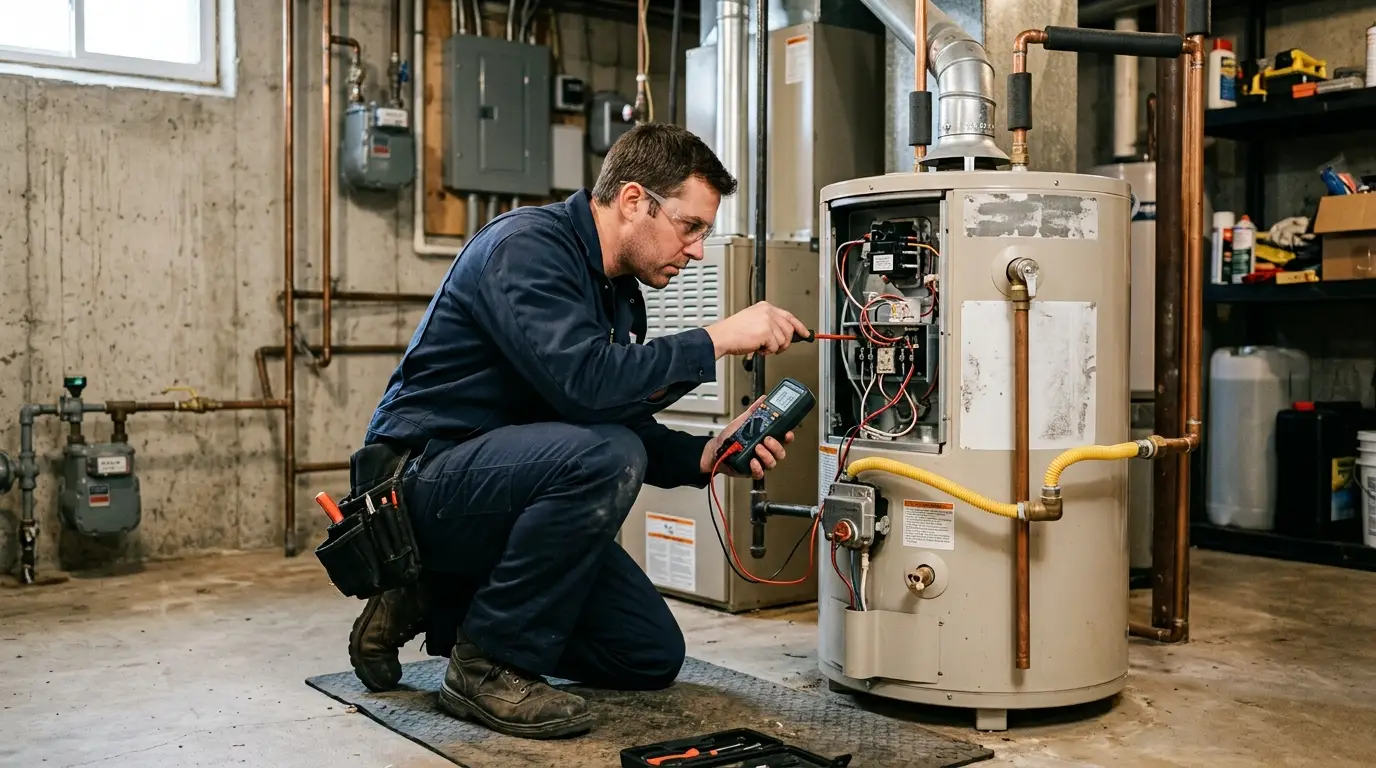
Cold showers, rusty water, banging from the tank or a puddle on the garage floor. Diagnosed properly, and told straight whether the repair is worth doing on a tank of that age.
Water pooling under the tank? Say so, that changes the advice.
Water heaters fail in a small number of recognisable ways, and each symptom points at a specific component. No hot water at all on a gas unit usually means the pilot, thermocouple, gas control valve or a tripped safety. On electric it is almost always a heating element or a thermostat, and frequently the upper one. Lukewarm water that runs out fast is often a failed lower element or a broken dip tube.
Rumbling and popping is sediment. Hard water leaves mineral deposits on the tank floor, and steam forming under that layer makes the noise. It is not immediately dangerous but it wastes gas and it is a sign the tank has been working hard for a while. Rusty hot water is more serious: it usually means the sacrificial anode is spent and the tank lining is being attacked.
A leak needs a proper look before anything else. Water from a fitting, a valve or the temperature-and-pressure relief line is repairable. Water weeping from the tank shell itself is not, the tank is rusted through and the only fix is a new heater. Being told which one you have, accurately, is most of what a diagnosis visit is for.
Bring the age of the unit to the conversation; it changes every answer.
A relief valve that is discharging is a safety device doing its job. Get it looked at rather than capped.
Age and model number on the phone speeds this up a lot.
Hard water is the main culprit. Mineral-heavy supply drops sediment on the tank floor where it insulates the water from the burner, so the burner runs longer, the steel runs hotter and the tank ages faster. That single mechanism explains rumbling, slow recovery, rising gas use and shortened tank life all at once.
High static pressure adds to it, stressing the tank, the relief valve and every connection, especially where no expansion tank is fitted. And a great many local units live in unconditioned garages, which is fine for the tank but hard on venting and combustion air if anything about the space has been changed since installation.
The root cause of rumbling, poor recovery and shortened tank life. Annual flushing genuinely helps if it is started early enough.
A closed system with high pressure and no expansion tank stresses the tank and trips the relief valve. Cheap to fix, expensive to ignore.
The anode corrodes so the tank does not. Once it is gone the tank is on borrowed time, which is why rusty hot water is bad news.
Garage conversions, added storage and altered vent runs cause intermittent pilot and combustion faults that look like part failures.
Diagnose, quote, then repair. Never the other way around.
The data plate gives the manufacture date, capacity and specification. On a twelve-year-old tank, the repair conversation is different from the same fault on a four-year-old one, and you deserve to know that before spending anything.
Gas supply, ignition and thermocouple, or element and thermostat continuity on electric. Temperature and pressure checked, relief valve inspected, and the source of any water traced to a fitting or the tank itself.
Repair cost, and replacement cost, with an honest read on the remaining life. If the fix is fifty dollars of parts you should hear that, and if it is throwing money at a rusted tank you should hear that too.
Parts replaced, sediment flushed where the tank warrants it, temperature set sensibly, and combustion or element operation checked under load before we leave.
Seismic strapping, drip pan and drain, expansion tank, vent condition and shutoff valve all checked. If something is missing or non-compliant, you get told and priced, not quietly ignored.
Same-day slots most weekdays.
Tank age is the variable that decides this more than the fault is.
Thermocouples, thermostats, elements, valves, dip tubes and relief valves are all routine parts. On a tank under about eight years old with a sound shell, repair is usually the obvious choice.
Trade-off: Spending on parts does not extend the life of the tank itself.
Draining sediment, checking the anode and setting temperature correctly. Restores efficiency and recovery on a neglected but healthy tank.
Trade-off: On a tank that has never been flushed in a decade, expect limited improvement, the damage is done.
Straightforward, predictable and the cheapest path back to reliable hot water when the existing tank is old or leaking. Fitted to current code with strapping, pan and expansion control.
Trade-off: Same technology, same lifespan, same hard water working against it.
Endless hot water and a longer service life, with gas sizing, venting and condensate all addressed properly at installation.
Trade-off: Higher upfront cost and a real descaling requirement in this water. Worth pricing, not worth assuming.
Most common repairs are modest: a thermocouple, an element, a thermostat or a relief valve are inexpensive parts with an hour or so of labour. Where cost climbs is a gas control valve, a difficult location such as an attic platform or a tight closet, or bringing a non-compliant installation up to standard at the same time.
The judgement call is age. Spending meaningful money on a tank past ten or twelve years is usually poor value, because you are buying a part for a vessel that is near the end regardless. We would rather tell you that and lose the repair than sell you the part.
Both numbers, so the comparison is yours to make.
Read the data plate. Model, serial and manufacture date. Photograph it and have it ready, it tells us the age and the parts before we arrive.
If it is leaking, isolate it. Close the cold inlet valve above the tank. If the leak is significant, shut the gas or breaker too.
Do not relight repeatedly. A pilot that will not stay lit is telling you something. Repeated attempts do not fix a thermocouple or a safety trip.
Clear the access. Storage stacked around a water heater is both a service obstacle and a combustion air problem. Moving it helps twice.
Where water heater calls lead.
Eight to twelve years is the realistic band for a tank in this water, sometimes longer with annual flushing and a replaced anode, sometimes shorter if it has never been serviced. Once you are past ten, treat any significant repair quote as a replacement conversation.
It depends on the part. A thermocouple or a relief valve, yes, small money, and it might give you two more years. A gas control valve or anything approaching a third of replacement cost, generally no. You will get our honest read with both numbers rather than a sales answer.
Usually a spent anode rod, meaning the tank lining itself is now corroding. Sometimes it is galvanized supply piping instead, which is a different problem. We can tell which by checking whether the discolouration appears on hot only or on both hot and cold.
Not immediately, it is sediment on the tank floor with steam forming underneath. It does mean the burner is working harder than it should, your gas use is higher than it needs to be, and the tank is aging faster. Flushing helps if it is caught reasonably early.
That is likely the temperature and pressure relief valve discharging, which means either excess pressure or excess temperature. It is a safety device working. Do not cap it, get the cause found, which is often high static pressure with no expansion tank fitted.
Yes, descaling, filter cleaning, ignition and flow sensor faults, and error code diagnosis. In water this hard, tankless units need regular descaling to keep working properly, and skipped maintenance is behind a large share of tankless faults.
Including the ones about whether it is worth fixing at all.
One visit tells you what failed, what it costs to fix, and whether fixing it is the right decision for a tank of that age.
(714) 598-4492The plumber we send gives you a firm price before work starts, and stands behind their own workmanship.