Undersized for current load
Appliances added over decades without recalculating. The reason a tankless unit or a pool heater underperforms.
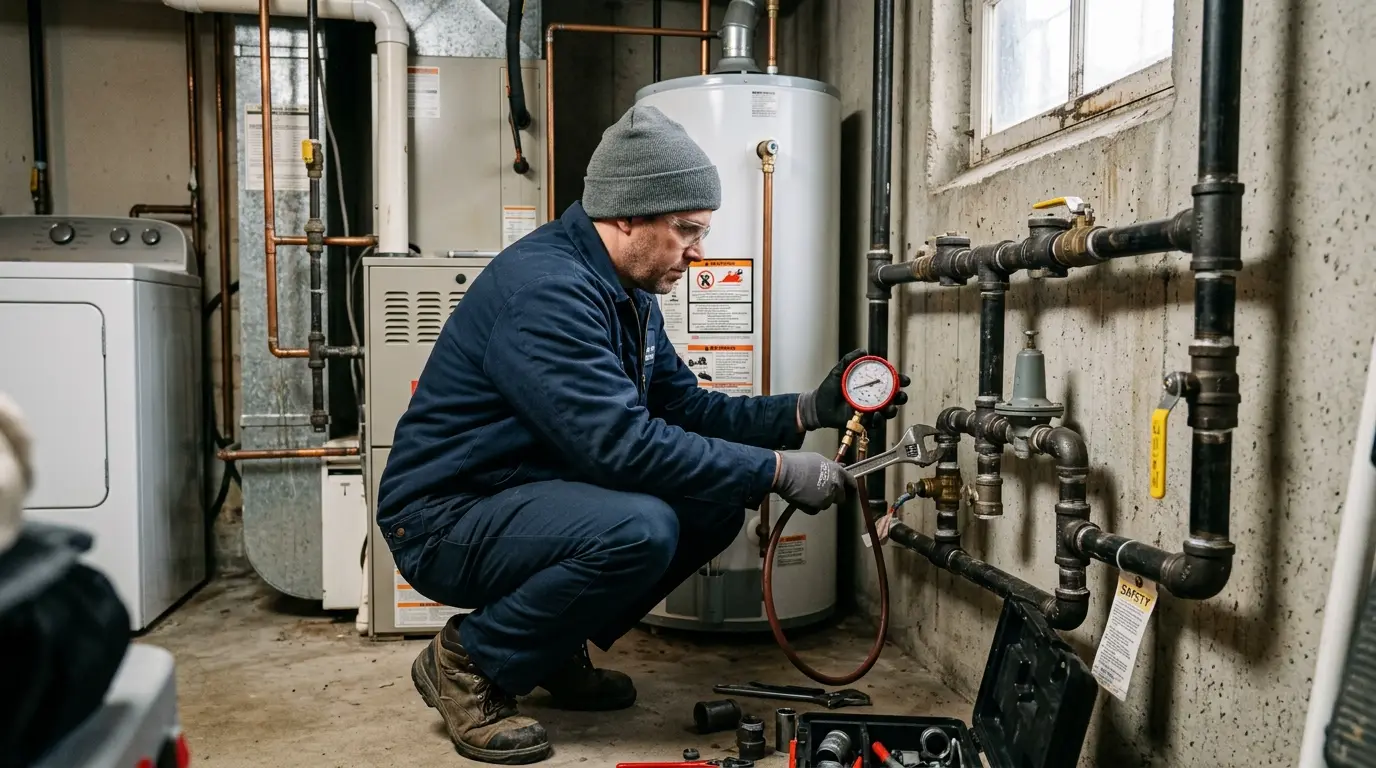
New runs for ranges, dryers, fire pits, pool heaters and tankless units, sized by proper load calculation, pressure tested and permitted. Plus leak testing and earthquake shutoff valves.
If you can smell gas, leave the building and call the gas utility first.
Every gas appliance has a BTU input rating, and every length of pipe has a capacity that depends on its diameter, its total developed length and the number of fittings in it. Adding an appliance means checking that the existing pipe can carry the new total load to every point at adequate pressure, and that the meter itself can supply it. That is a calculation with a right answer, not a judgement call.
Undersizing does not produce an obvious failure. It produces appliances that underperform when several run at once: a tankless heater that will not reach temperature while the furnace is running, a range that never gets a proper flame, a pool heater that trips. These get blamed on the appliance for years when the cause is the pipe feeding it.
The safety side is straightforward and non-negotiable. New and altered gas piping is permitted work, pressure tested before it is put into service, and inspected. Connections are made with proper materials and appliance connectors rather than improvised fittings, and every joint is tested. There is no version of this job where those steps are optional.
If you smell gas, do not start here, leave the building and call the gas utility.
Suspected leak: leave the building, do not touch switches, and call the gas utility from outside. Then call us for the repair.
Appliance list and meter details make this quick.
The most common issue is capacity, not condition. Homes here were piped for the appliances of their era, and they have since gained a second dryer, a fire pit, an outdoor kitchen or a tankless water heater. Each addition was reasonable on its own, and nobody re-ran the load calculation, so the system is now working at or past what the pipe can carry.
The second is legacy work. Abandoned stubs left uncapped from removed appliances, flexible connectors well past their service life, unions in the wrong places, and exterior runs corroding at the point where the pipe enters the ground. None of these are dramatic and all of them are worth correcting when found.
Appliances added over decades without recalculating. The reason a tankless unit or a pool heater underperforms.
Uncapped stubs, aged flexible connectors, unions in inaccessible places. Common, unglamorous, worth fixing.
Black iron rusting at the soil line where it passes into the ground. Inspected on every gas visit.
An automatic valve closes the supply during significant shaking. Increasingly expected, and simple to fit at the meter.
Calculate, permit, install, test, inspect. In that order, every time.
Every gas appliance listed with its input rating, the existing pipe measured for diameter and developed length, and the total load checked against capacity, including meter capacity.
The run planned for the shortest practical path with proper support and protection, avoiding concealed joints, with sleeving where it passes through or under structure.
New and altered gas piping requires a permit and inspection. We pull it and schedule the inspection as part of the job rather than leaving it to you.
Pipe installed in approved materials, appliance connectors and shutoffs fitted, then the system pressure tested and held before any appliance is connected and lit.
Appliances connected, lit and checked under load, every joint leak tested, and the work signed off at inspection. You get told what was changed and what the system can now carry.
Routing, sizing, permit and testing included.
Four categories that cover nearly every call.
A new line to a range, dryer, fire pit, outdoor kitchen, pool heater, generator or tankless unit, with the correct shutoff and connector at the appliance.
Trade-off: Cost is driven by distance and routing difficulty far more than by the appliance itself.
Replacing an undersized section, or the main run, so the whole system delivers adequate pressure with everything operating.
Trade-off: Less visible than a new appliance but often the reason the new appliance will work at all.
Pressure testing to confirm or locate a leak, then repairing or replacing the affected section, retesting and documenting the result.
Trade-off: Locating on a concealed run can require access openings. Testing tells us where before we open anything.
An automatic seismic valve at the meter that closes the gas supply during significant shaking. Small job, meaningful protection in this region.
Trade-off: Requires resetting after it triggers, which is a minor inconvenience against the alternative.
Cost is driven by the run: how far, through what, and how accessible. A short run from a nearby manifold to a patio fire pit is modest. A long run from the meter through a crawlspace, under a driveway or up to a second floor is not. Upsizing an existing main run is priced similarly to a new run of the same length.
Permit and inspection are part of the price and should be in any quote you compare. A gas quote without a permit line is not cheaper, it is unpermitted, and that becomes your problem at sale, at insurance renewal, or the first time anything goes wrong.
Priced on distance, routing and load, not per appliance.
If you smell gas, leave. Do not operate switches, do not use the phone indoors. Get outside, then call the gas utility from there. They come for free and they come quickly.
Know where the meter shutoff is. And keep the right size wrench near it. Every adult in the house should know this.
Do not use flame to find a leak. Or improvised fittings, or hardware-store adapters on gas. This is the one area with no room for approximation.
Cap abandoned stubs. If an appliance was removed and a capped-off pipe is still live, get it checked and properly capped.
Gas work touches appliances on both ends, so the heater and the fixture pages are the usual companions.
Leave the building. Do not switch anything on or off, including lights, and do not use a phone indoors. Once outside, call the gas utility, they respond to suspected leaks without charge and they respond fast. Call us afterwards for the repair work once the supply is safe.
That is exactly what a load calculation answers. It depends on the input rating of everything you already have, the pipe diameter, the total developed length and your meter capacity. Sometimes there is plenty of headroom; sometimes a section needs upsizing. Either way it is a number, not an opinion.
Yes, for new or altered gas piping. It exists so the work is pressure tested and inspected, which on gas genuinely matters. We pull the permit and handle the inspection, and it is itemised in the quote.
It is an automatic valve at the meter that closes the gas supply when it senses significant shaking, reducing fire risk after a quake. In this region it is a sensible thing to have, and some situations and insurers expect it. It is a small, quick job.
Very often the supply, not the appliance. If a tankless heater will not reach temperature while the furnace runs, or a range flame drops when the dryer is on, the line is likely at capacity. A load calculation and a pressure check under load will confirm it.
Yes, a permitted run with the correct sizing, proper protection where it is buried or exposed, and a shutoff at the appliance. Distance and routing set the cost, so it is worth deciding the final location before we quote.
Sizing, capacity and whether your meter can take another appliance.
Load calculated, run planned, permit pulled, system pressure tested, and every appliance checked under load.
(714) 598-4492The plumber we send gives you a firm price before work starts, and stands behind their own workmanship.