Line and meter capacity
Full load calculation across all appliances. Upsizing a run is common and needs to be in the quote, not discovered on install day.
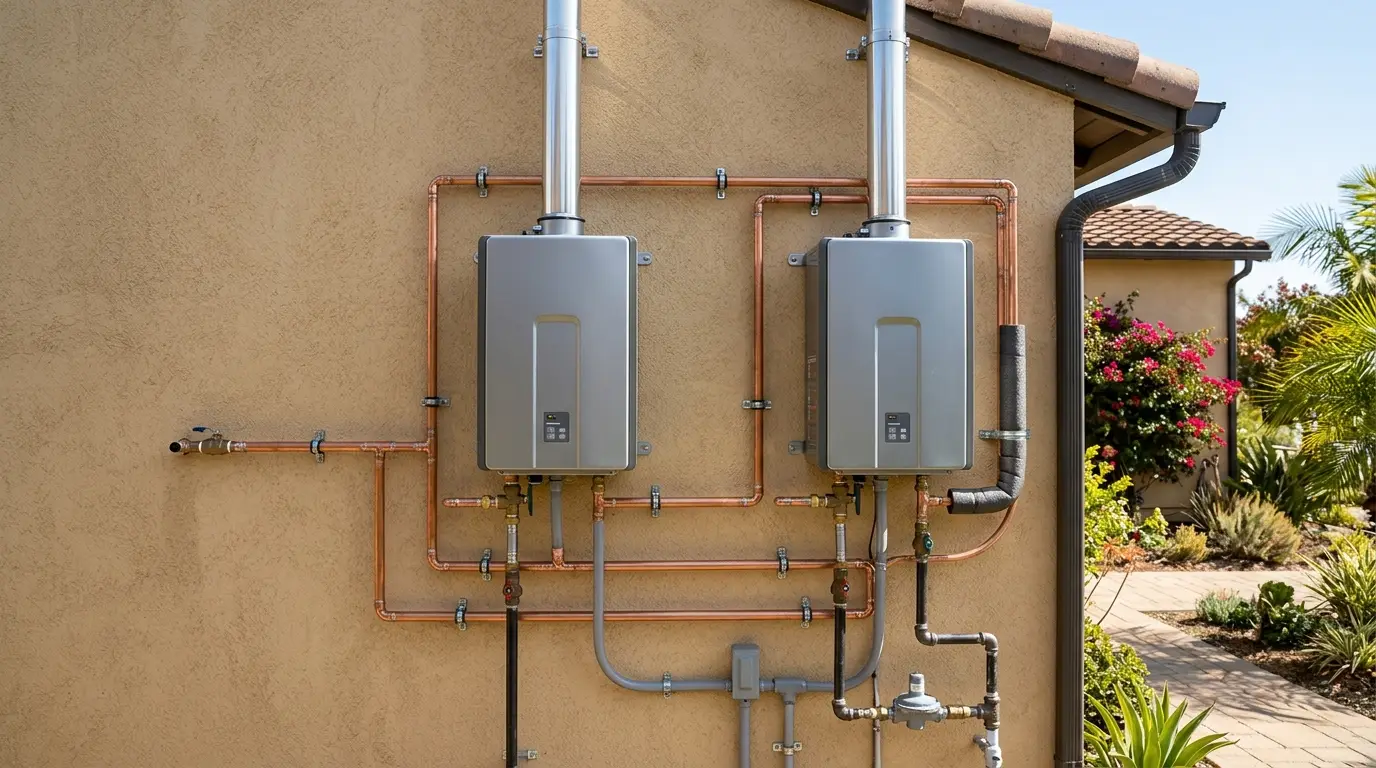
A tankless unit is only as good as its gas supply, its venting and its maintenance plan. We size all three properly for hard local water, and tell you honestly when a tank is the better buy.
Meter size and gas appliance list help us answer quickly.
A tankless heater heats water as it flows, so there is no stored volume to run out and no tank sitting at temperature all day. The benefits are real: hot water that does not end, a wall-mounted unit that frees floor space, lower standby losses, and a service life that commonly runs to twenty years against eight to twelve for a tank.
The constraints are equally real. Output is measured in flow rate at a given temperature rise, so the right way to size one is to add up the fixtures you genuinely run at once. Two showers plus a kitchen tap is a different unit from one shower. Undersizing is the most common cause of disappointment, and it is not fixable afterwards without replacing the unit.
It is also not a swap. A gas tankless unit typically needs far more gas input than the tank it replaces, so the gas line and sometimes the meter capacity have to be assessed. It needs its own stainless or concentric venting rather than the old flue. A condensing unit needs a condensate drain. Anyone quoting a tankless install without discussing those three things has not looked at your house.
It suits some households very well and others poorly. Be honest about which you are.
If nobody in the house will book annual descaling, a tank is the better purchase. That is a real answer, not a sales one.
We check gas capacity and venting routes before quoting.
Gas capacity comes first. A tank might draw around 40,000 BTU while a whole-house tankless unit can want 150,000 to 199,000. That load has to travel down existing pipe alongside your range, dryer and furnace. Sometimes the existing line is adequate, often a section needs upsizing, and occasionally a meter upgrade is required. This is a calculation, not an opinion.
Then venting and condensate. Tankless units need their own dedicated stainless steel or concentric venting, and the old atmospheric flue cannot be reused. Condensing models produce acidic condensate that needs a proper drain and often neutralisation. Both dictate where the unit can physically go.
Third, water. Tustin water is hard, and scale on a heat exchanger is what kills tankless performance. Annual descaling with isolation valves fitted at installation is straightforward maintenance. Without those valves it is an awkward job that gets skipped, and skipped descaling is behind most tankless complaints in this area.
Full load calculation across all appliances. Upsizing a run is common and needs to be in the quote, not discovered on install day.
The old flue cannot be reused. Vent routing frequently determines where the unit is mounted, and how much the job costs.
Condensing units produce acidic condensate needing an approved drain, and often a neutraliser cartridge to protect the drain line.
Isolation valves fitted at install make annual descaling a routine visit. Without them, maintenance gets deferred and the exchanger pays for it.
The assessment is where a good tankless job is won.
Count the fixtures that genuinely run together and calculate the flow rate needed at the temperature rise our incoming water requires. This produces the unit specification, and it is the step most commonly skimped.
Full gas load calculation across every appliance, pipe run measured and sized, meter capacity checked, and a vent route and mounting location worked out. You get told the real scope, including any gas upsizing.
Supply reconfiguration, isolation and service valves for descaling, condensate drain route and neutralisation, plus a recirculation decision if long waits at distant fixtures matter to you.
Unit mounted, gas and water connected, venting installed to the manufacturer specification, condensate piped, then leak testing, temperature setting and firing across the flow range under real conditions.
Permit and inspection, then a walkthrough: how to read the display and error codes, what the service interval is, and where the isolation valves are so descaling is easy.
Itemised, including gas and venting work.
Not every tankless project is one unit on a garage wall.
One high-output condensing unit serving the entire house. The most common configuration, best efficiency, and it needs a condensate drain.
Trade-off: Highest gas demand, so it is the configuration most likely to require gas line upsizing.
Simpler and cheaper to buy, no condensate handling, and a good fit where the venting route is short and straightforward.
Trade-off: Lower efficiency and stricter venting material requirements. Running cost is higher over a long service life.
A small unit serving one distant bathroom, a guest suite, an ADU or a kitchen a long way from the main heater. Removes a long wait without re-plumbing the house.
Trade-off: Solves one location only. Two or three of these is usually worse value than one central unit.
A recirculation loop or a built-in pump so hot water arrives quickly at distant fixtures rather than after a long run-off.
Trade-off: Extra cost and some standby energy use, but it fixes the one complaint people have after switching.
Tankless installation costs more than a tank replacement, usually substantially, and the unit is often not the largest part of the difference. Gas line upsizing, new stainless venting, condensate drainage and permit work are where the money goes. That is why an itemised quote matters more here than on any other job on this site.
On running cost, tankless generally wins on standby losses and lasts longer. Whether that returns the difference depends on how long you stay, how much hot water you use and how diligent you are with descaling. We will lay out both numbers for your house and let you decide. Sometimes the answer is a high-efficiency tank, and we will tell you when it is.
Upfront, running and maintenance, side by side.
Count your simultaneous fixtures. Two showers at once is the usual sizing question. Get this right and you will be happy with the unit for twenty years.
Ask about gas sizing explicitly. If a quote does not mention the gas load calculation, it is not a complete quote. Ask what happens if the line needs upsizing.
Insist on isolation valves. They make annual descaling a routine visit instead of an awkward job. Non-negotiable in water this hard.
Be honest about maintenance. Tankless rewards a service interval and punishes neglect. If that is not you, a good tank is the better purchase.
A conversion depends on gas, water treatment and pressure, so these pages are worth reading beside it.
It will not run out, but it does have a flow limit. Size it for the fixtures you actually run at once and you will never notice a ceiling. Undersize it and you will get temperature drop when a second shower starts, which is why the sizing calculation matters more than the brand.
Often, yes. A whole-house tankless unit can demand several times the gas input of the tank it replaces, and that load shares the line with your range, dryer and furnace. A proper load calculation gives the answer, and it belongs in the quote rather than appearing on installation day.
Annually in water as hard as ours, sometimes more if you have very high mineral content and no softener. With isolation valves fitted at installation it is a routine service visit. Skipped descaling is the leading cause of poor tankless performance locally.
It depends on how long you are staying and how you use hot water. A long stay, high usage and a household that keeps up with maintenance make the economics good, helped by a service life roughly double a tank. A short stay or minimal usage often does not recover the difference, and we will say so.
Outdoor-rated models exist and are commonly used in this climate, which simplifies venting considerably. Freezing is not the concern here that it is elsewhere, though the unit still needs sensible siting, protection and access for service.
That is the cold water sandwich, a slug of unheated water sitting in the pipe between draws. Modern units minimise it with better controls, and a recirculation loop or a small buffer tank largely removes it. Worth designing for up front if you have short repeated draws.
We will say when a tank makes more sense for your house.
Real load calculations, correct venting, condensate handled, isolation valves fitted, and an honest answer if a tank suits you better.
(714) 598-4492The plumber we send gives you a firm price before work starts, and stands behind their own workmanship.