Strapping at two points
Upper and lower straps, correctly anchored. Frequently missing or improvised on older installations, and an easy inspection failure.
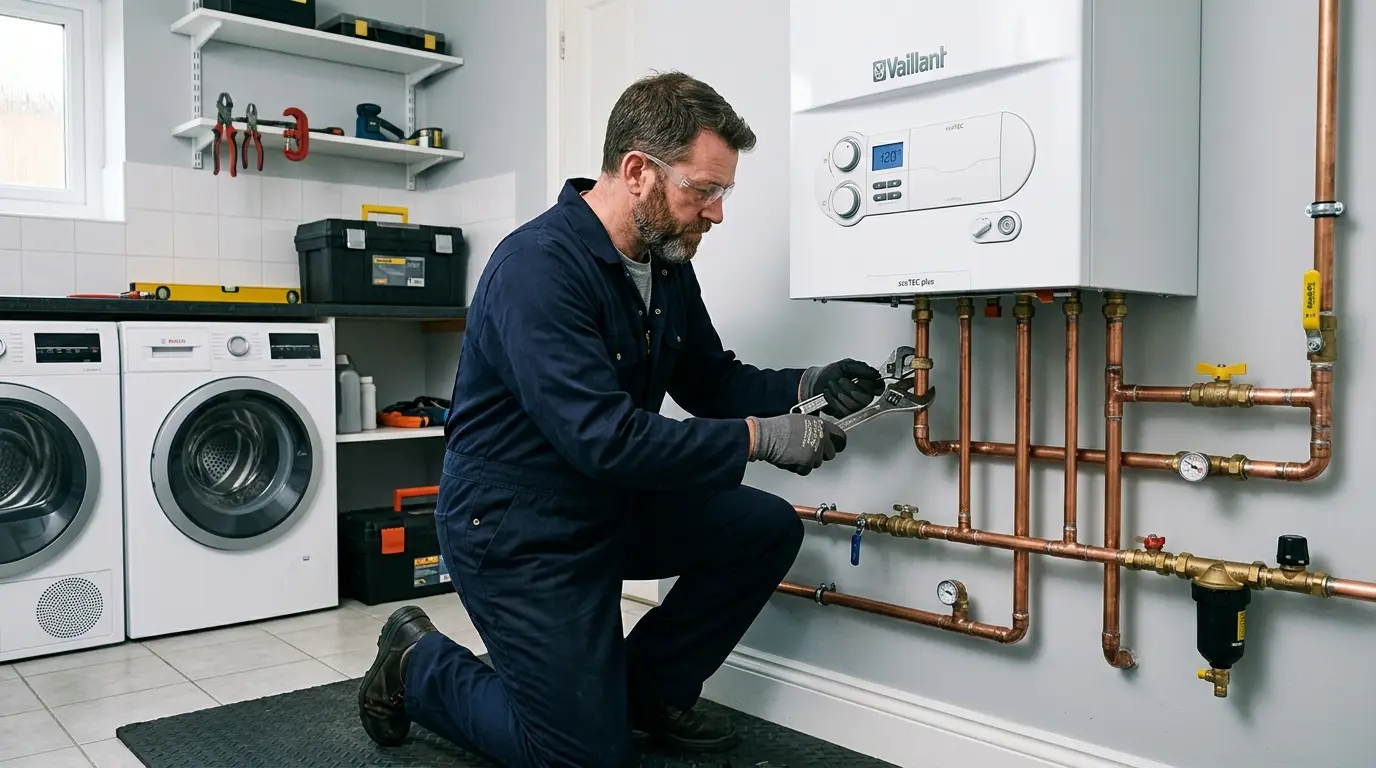
A replacement tank sized for the household, strapped and vented properly, with expansion control fitted and the permit pulled. Usually a single-day job, old unit taken away.
Capacity, fuel type and location on the phone gets you a real number.
Most replacement heaters get chosen by matching the label on the old one, which is only right if the old one was right. The number that actually matters is first-hour rating: how much hot water the unit can deliver during your peak hour. A household where three showers, a dishwasher and a washing machine overlap in the morning has a different requirement from one where they do not, even at identical square footage.
Fuel type is usually decided for you by what is already there. Converting between gas and electric means either new gas piping and venting or a substantial electrical upgrade, so it is a remodel decision rather than a replacement decision. What is genuinely open at replacement time is capacity, efficiency level, and whether to consider tankless instead.
Location drives more of the cost than people expect. A tank on a garage floor with an existing pan and drain is the easy case. An attic platform or a narrow interior closet means harder access, stricter drain and pan requirements, and more labour, the same unit, a different job.
Any of these and installation is the conversation.
A tank leaking from the shell cannot be repaired. That one is not a judgement call.
Most tank replacements are done same-day or next-day.
A water heater installation in California is not just a plumbing connection. Seismic strapping at two points is required. An expansion tank is needed on a closed system, which most local homes are, and in high-pressure areas it is what stops the relief valve discharging. Combustion air and vent sizing must be correct for the appliance and the space, and a garage installation has its own elevation and protection requirements.
Then there is water chemistry. Hard water shortens tank life here, so the details that seem optional (a functioning anode, an accessible drain valve, annual flushing) are what determine whether you replace this unit in eight years or thirteen. A good installation makes maintenance easy rather than awkward.
Upper and lower straps, correctly anchored. Frequently missing or improvised on older installations, and an easy inspection failure.
An expansion tank on a closed system protects the heater and stops nuisance relief valve discharge. Small cost, large consequence.
Correct vent sizing, rise and connection, plus adequate combustion air. Garage storage and later remodels routinely compromise both.
Required where a leak would cause damage, attic platforms and interior closets especially. Piped to an approved location, not the floor.
Typically half a day for a straightforward tank swap.
Capacity and first-hour rating for your household, fuel type, venting configuration and physical fit. Measured, not assumed, new units are not always the same dimensions as the one coming out.
Water and gas or power off, tank drained, connections broken. Floors and doorways protected on the removal path before anything moves.
Old unit out and taken away for disposal. It is included, not an extra line item discovered at the end.
Positioned with proper clearances, connected with new flex connectors and shutoff, strapped at two points, pan and drain fitted, expansion tank installed and vent connected correctly.
Filled and purged of air, gas connections leak tested, temperature set sensibly, combustion or element operation confirmed, and the permit inspection arranged.
Water off for a few hours, not a day.
Four realistic paths at replacement time.
Conventional gas tank with a natural draft vent. Lowest upfront cost, simplest replacement, widely available parts. The default for a like-for-like swap.
Trade-off: Lowest efficiency of the options and the same eight-to-twelve year expectation in hard water.
Better insulation and combustion, often power-vented, giving lower running cost and more flexible venting and siting.
Trade-off: Higher purchase price, needs an electrical outlet, and condensate handling on some models.
Substantially lower running cost by moving heat rather than making it. Well suited to a garage installation with the space and air volume it needs.
Trade-off: Highest upfront cost, needs adequate electrical capacity, space and condensate drainage, and recovery is slower.
Endless hot water, compact, long service life. Requires correct gas sizing, new venting and a descaling plan for this water.
Trade-off: A different project, not a swap. Worth pricing properly rather than deciding on the spot.
The unit is the visible number and the install details are where quotes diverge. A cheap quote that omits strapping, an expansion tank, a new shutoff, a pan and drain, permit, or haul-away is not cheaper, it is a different scope, and the difference tends to surface at inspection.
Ask any installer for an itemised list: unit and capacity, connectors and valve, strapping, expansion tank, pan and drain, vent work, permit and inspection, haul-away. Once you have that from two companies you are comparing prices instead of comparing omissions.
Including code items, which is where cheap quotes hide.
Photograph the data plate. Capacity, fuel type and manufacture date. Also photograph the space around it, including the vent.
Count your peak hour. How many showers and appliances overlap on the worst morning of the week. That is what sizing should be based on.
Ask what is included. Strapping, expansion tank, pan, permit, haul-away. Get it itemised and the comparison becomes easy.
Check the pressure too. High static pressure shortens the life of a new heater. Worth reading and correcting while the work is happening.
Installation decisions run into water hardness, pressure and gas supply. These cover each of those.
Base it on peak-hour demand rather than square footage. As a rough guide, a 40-gallon gas tank suits a smaller household, 50 gallons is the common choice for three or four people, and larger households or homes with a soaking tub want more capacity or a higher first-hour rating. We will size it on your actual morning, not a table.
Yes, replacement generally requires a permit and inspection, which exists to catch exactly the things cheap installs skip, strapping, venting, expansion control and pan requirements. We pull it as part of the job.
A straightforward like-for-like tank swap is commonly three to five hours including draining, removal and commissioning. Add time where venting changes, an expansion tank has to be added, or access is difficult such as an attic platform.
Yes. Removal and disposal are included in the quote rather than added at the end.
Running cost is substantially lower, so over a full service life the economics are often good, but it needs electrical capacity, physical space, air volume and condensate drainage, and recovery is slower than gas. In a spacious garage it is a strong option. In a tight interior closet, it usually is not.
Often yes, though it changes how warranty works: the manufacturer warranty is yours to administer and we stand behind the installation labour only. We will also check the unit is right for the space before fitting it, and tell you if it is not.
Household size and peak-hour demand decide this, not guesswork.
Correct capacity, code-compliant install, permit pulled, old unit gone, usually inside a single day.
(714) 598-4492The plumber we send gives you a firm price before work starts, and stands behind their own workmanship.