Hard water from inside
Mineral-heavy supply scours and thins copper from the bore outward, worst at elbows where flow changes direction.
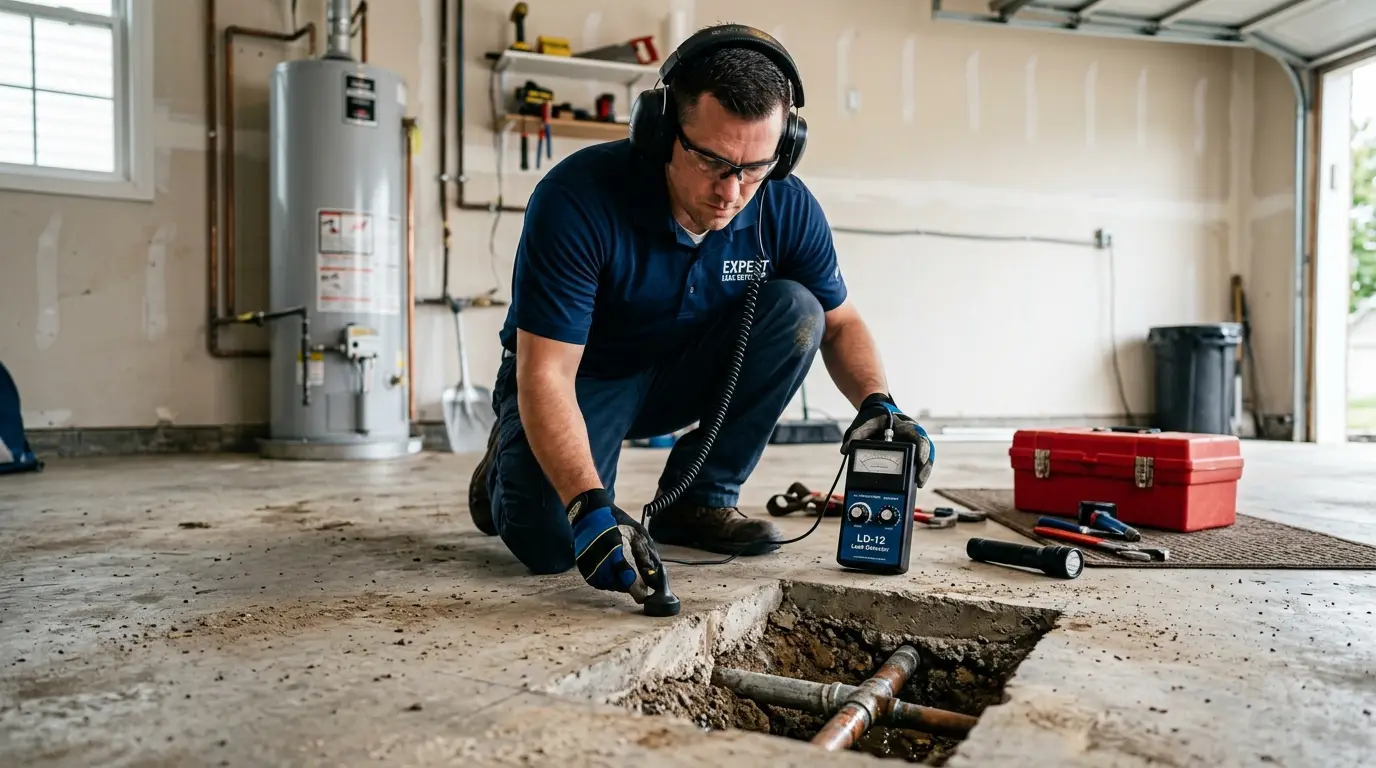
A line leaking under your foundation shows up as a warm patch, a meter that never rests and a bill that climbs. Located electronically first, then either opened and repaired or rerouted around the slab entirely.
Warm spot on the floor? Take a meter reading before you call, it helps.
Post-war and post-1960s tract housing across Tustin was largely built on concrete slab-on-grade, with water lines run through or beneath that concrete rather than in a crawlspace. When one of those lines fails, the water has nowhere to go but into the sub-grade and along the underside of your floor. That is a slab leak: a pressurised line failing in the one place you cannot see, reach or dry out.
The tell that separates it from an ordinary leak is heat. Hot-water lines fail more often than cold, because heat accelerates the chemistry that thins copper. So the classic first symptom is a patch of floor that is noticeably warm underfoot in a spot with no sunlight and no heating below it, often noticed by someone barefoot, or by a dog that has started sleeping in an odd place.
The second tell is the meter. A slab leak does not stop when the house goes quiet. Close every fixture, watch the meter dial, and if it is still moving, water is escaping somewhere that is not a fixture. Combined with a warm floor, that is a strong enough signal to justify a proper locate.
The early ones are subtle. The late ones are expensive.
Left long enough, a slab leak stops being a plumbing problem and becomes a foundation and flooring one.
Locating comes first. Nobody should be cutting concrete on a guess.
Three local factors stack against buried copper here. The imported water is hard and mineral-heavy. Static pressure in parts of central Orange County runs high enough to shorten the life of any thin-wall line. And expansive soil moves seasonally, so a line cast into concrete or resting in sub-grade is worked back and forth for decades.
Add the installation practice of the era. Lines were often laid without sleeves, so copper sits in direct contact with concrete and soil. Concrete is alkaline, soil holds moisture and chlorides, and unsleeved copper under compression at a bend is exactly where you find the pinhole thirty years later.
Mineral-heavy supply scours and thins copper from the bore outward, worst at elbows where flow changes direction.
A failed or absent regulator pushes street pressure through the house day and night. Buried lines have no slack to absorb it.
Seasonal swelling and shrinking flexes anything cast into or laid beneath the slab. Rigid pipe eventually loses.
Direct contact between copper, concrete and damp soil sets up corrosion that a sleeve would have prevented.
Locating is the whole job. The concrete work is the easy part once you know exactly where to open.
Isolate the water heater and branches to establish whether the loss is on the hot or cold side, and rule out irrigation, the main and drain lines. Some suspected slab leaks are a leaking hose bib and a coincidence.
Acoustic listening equipment on the floor, pressure testing on the isolated line, and where useful a thermal read to map the hot run. The output is a marked spot, not a marked room.
Open the slab at the marked point, or reroute the line overhead and abandon the buried section. You get both prices, with an honest read on which one makes sense for the age of your pipe.
Concrete cut and shored, or the new run installed and supported. Line pressurised, held under test, then the opening backfilled and patched to floor level.
Static pressure checked and a regulator recommended if it reads high. Repairing a slab leak without correcting 90-plus psi is a temporary result.
Most locates are completed in the same visit as the diagnosis.
One number rarely decides this. Pipe age and leak history decide it.
Cut a small opening in the concrete at the located point, replace the failed section, patch back. Right when the pipe is otherwise healthy and the leak is a one-off.
Trade-off: Least disruption to the rest of the house, but you are leaving the remaining pipe where it is.
Run a new line through the attic and down interior walls, abandoning the under-slab section. The most common choice for hot-water slab leaks in single-storey tract homes.
Trade-off: Drywall openings and patching, but the pipe is accessible forever after.
For a house with multiple failures, feed each fixture group from a new manifold rather than repairing the old distribution piecemeal.
Trade-off: Bigger project, but it converts an unpredictable leak history into a known one-time cost.
On a house that has already had two or three slab leaks, replacing the system ends the cycle rather than deferring it.
Trade-off: Highest upfront cost. Often the cheapest option measured over five years.
Slab leak pricing splits into two invoices in most peoples minds: finding it and fixing it. Locating is the smaller number and the one worth paying for properly, because an accurate locate is what keeps the repair small.
What drives the fix is access and finish. A leak under a garage slab is straightforward. The same leak under a marble bathroom floor with cabinetry over it is a different job, and the flooring restoration may exceed the plumbing. We will tell you where the money is going before we start, and we will tell you when a reroute is cheaper than opening your floor.
You get both numbers before you decide which way to go.
Take a meter reading. Note the exact numbers with everything off, wait an hour, read again. That number tells us a great deal.
Mark the warm spot. Tape on the floor where the heat is strongest. Symptoms move once water gets moving, so the first observation is the useful one.
Isolate the water heater. If closing the water heater cold inlet stops the meter, the leak is on the hot side, and that halves the search area.
Skip the DIY moisture meter. Surface readings on concrete mislead constantly. Acoustic location is what actually finds these.
Slab leaks sit next to these calls more often than any other service on the site.
Two tests get you most of the way. Shut every fixture and watch the meter, if it moves, water is escaping outside the fixtures. Then close the cold inlet on the water heater; if the meter stops, you have a hot-side leak, which is the classic slab leak pattern. Neither test is proof, but together they justify a locate.
Not always. For hot-water leaks in single-storey homes, an overhead reroute avoids the slab entirely and often costs about the same as opening the concrete and patching it back. When a spot repair is the better answer, the opening is small because the locate is precise.
A located spot repair is commonly a one-day job. A reroute of one line typically runs one to two days including drywall access. A full repipe is a multi-day project. You will get a realistic schedule before work starts, not an optimistic one.
Over time, yes. Continuous water in expansive soil under a slab changes how that soil supports the concrete, which is why sticking doors and new cracks belong on the symptom list. It is a slow problem, not an overnight one, but it is the reason not to leave a known slab leak running for a year.
Policies vary widely. Many cover the resulting damage and the cost of accessing the leak while excluding the pipe itself, and most exclude long-term seepage. Ask your carrier before you commit, and ask us for written documentation of what we found, that is the part adjusters want.
That is the point where the conversation stops being about this leak. Two failures in the same era of pipe usually means more are forming. We will price the immediate repair and a repipe together so you can make the decision with real numbers instead of a hunch.
Happy to tell you it is probably not a slab leak, if that is what the symptoms say.
Warm floor, spinning meter, rising bill, call it in and get a proper locate rather than an exploratory hole.
(714) 598-4492The plumber we send gives you a firm price before work starts, and stands behind their own workmanship.