Root intrusion at joints
Fine roots enter at clay joints, thicken, then catch paper and grease. Clearing works until the pipe is repaired at the entry point.
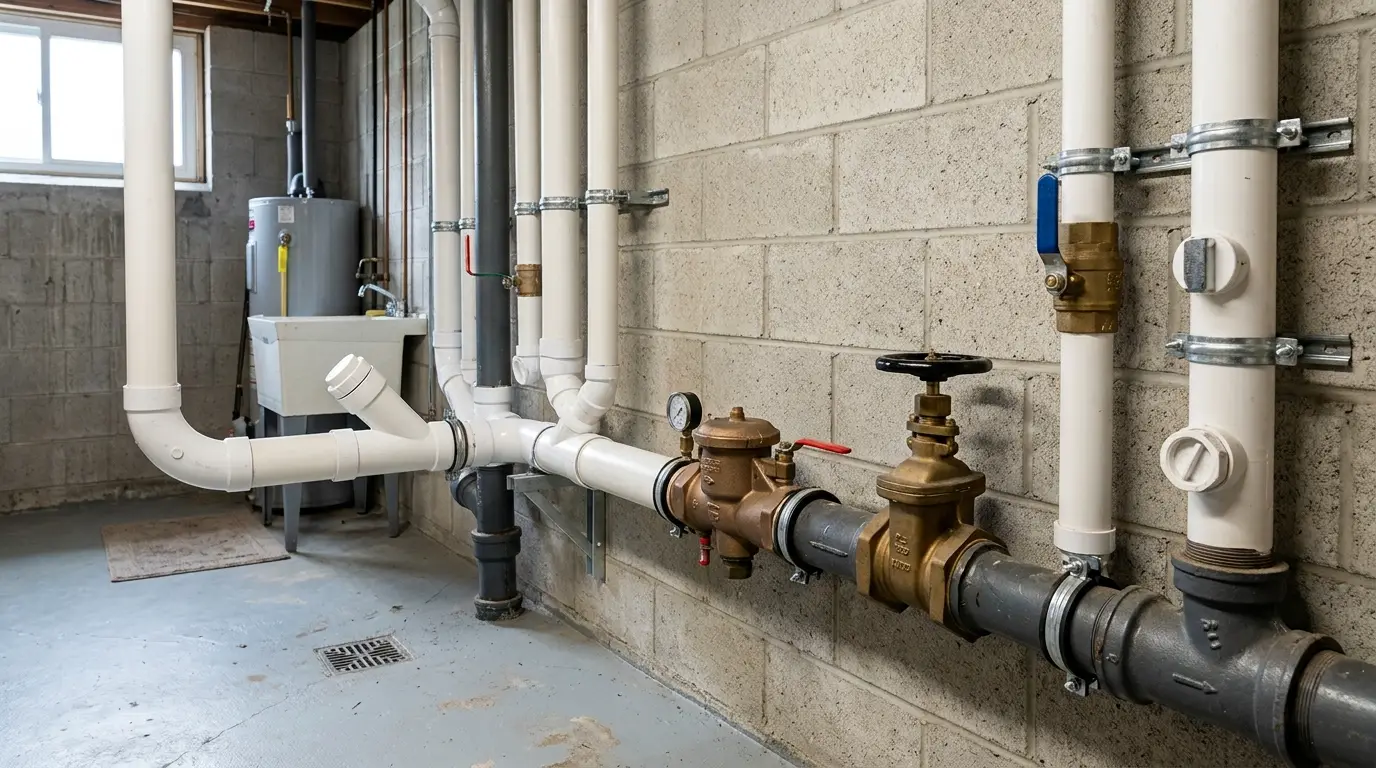
The lateral between your house and the city main is the pipe nobody thinks about until it backs up. Diagnosed on camera, then repaired at the defect, lined, or replaced, with the reasoning shown to you first.
Backing up right now? Say so, that changes how we schedule you.
Your sewer lateral runs from the house, under the yard and often under the parkway, to the city main in the street. It is gravity-fed, so it depends on continuous fall and an unbroken bore. Everything that goes wrong with it comes down to one of those two things being interrupted.
In older Tustin neighbourhoods the lateral is clay or cast iron. Clay comes in short sections with joints every few feet, and those joints are where roots get in. Cast iron corrodes from the inside until the bottom of the pipe thins and the bore roughens. Both are working well past their design life in parts of this city, and both fail in patterns a camera can read easily.
The other failure is geometry. Soil movement and settlement create offsets, where two sections no longer line up, and bellies, where a length has sagged into a dip that holds water. Neither blocks the line on its own. Both catch solids and paper until something does.
These are the signals to take seriously rather than plunge at.
Recurring main line blockages are the classic sign of a pipe defect, not of bad luck.
Camera and locate, so you know the defect and its depth.
Mature street trees are the headline cause. Tustin has a lot of them, and they are exactly as old as the clay laterals they grow beside. Roots seek moisture and find it at a joint or a hairline crack, then thicken inside the pipe, catching everything that passes and eventually displacing the joint itself.
Underneath that sits soil and time. Expansive clay soil moves with the seasons, which works joints loose and pulls sections out of alignment. Add a few decades of corrosion in cast iron, plus the occasional length crushed by later construction or a driveway pour, and you have the four defects that account for nearly every lateral repair we do.
Fine roots enter at clay joints, thicken, then catch paper and grease. Clearing works until the pipe is repaired at the entry point.
Sections shifted out of line by soil movement leave a lip that snags solids. Cabling passes it; nothing else does.
A sagged length holds standing water and settles solids. Cleaning empties it; only re-grading the pipe fixes it.
Cast iron thinning from the inside until the invert is gone or the pipe collapses. At this point you are replacing, not cleaning.
Nothing gets dug until the defect, the depth and the route are known.
A blocked line cannot be inspected. We clear it first so the camera has a path, which also gets your house usable while the repair is being planned.
A recorded run from cleanout to main, noting each defect and its distance. Then an electronic locate marking position and depth on the surface, so the excavation plan is drawn from facts.
Spot repair, trenchless lining or full replacement, with the pros and costs of each. If two options are genuinely close, we say that rather than steering you.
Lateral work generally requires a permit, and work in the parkway or street means coordinating with the city. We handle that paperwork and scheduling, it is part of the job, not an afterthought.
The defect is repaired to code with correct bedding and fall, tested, and the site backfilled and compacted properly. Hardscape and landscape restoration is scoped and priced up front, not discovered later.
You see the footage, not a summary of it.
Which one is right depends on the defect, its length and what is on the surface above it.
Excavate at one located defect and replace a short section, a root-invaded joint, a crushed length, a single offset. Right when the rest of the pipe looks sound on camera.
Trade-off: Cheapest and quickest, but only sensible when the camera shows the rest of the line has life left.
A resin liner cured in place inside the existing pipe creates a jointless new bore without a trench. Well suited to long clay runs under driveways and mature landscaping.
Trade-off: Needs a host pipe with sound geometry, it will not fix a belly or a badly collapsed section, and it slightly reduces diameter.
A trenchless full replacement that pulls a new pipe through the path of the old one, with access pits at each end. Used when the existing pipe is too far gone to line.
Trade-off: More disruption than lining, far less than an open trench, and it can correct diameter.
Dig the line and lay new pipe at correct fall. The only real answer to a bellied run, a change of route or a line that has collapsed along its length.
Trade-off: Most disruptive and most expensive, and the only option that fully re-grades the pipe.
This is the widest price range on the site, and any figure quoted before someone has seen the camera footage is a guess. A single spot repair in open lawn and a full replacement running under a driveway and out to the street belong to different orders of magnitude.
The pipe is a small part of it. The cost lives in depth, length, what sits above the line, permits, and restoration. Get the camera and locate done first, that turns a frightening unknown into a number you can plan around, and it is also what lets you compare quotes on equal terms.
Spot repair, liner and full replacement, side by side.
Stop running water if it is backing up. Every flush adds volume to what is coming into the house. Get the line cleared before you use fixtures again.
Ask where responsibility divides. Homeowners are typically responsible for the lateral including the portion in the parkway, with the city responsible for the main. Worth confirming for your property before you agree to anything.
Get the footage on file. A recorded inspection is your leverage, for comparing quotes, for a real estate transaction, and for showing an insurer or a neighbour whose tree is involved.
Buying a house here? A camera inspection of the lateral costs very little against the price of a home and regularly changes the negotiation.
What sits either side of a lateral repair.
A camera answers it, and nothing else does reliably. Cleaning is the right answer for a one-off blockage in a sound pipe. If the same line blocks repeatedly, there is a reason inside the pipe (roots at a joint, an offset, or a belly) and cleaning is a rental payment against a repair.
In most Orange County jurisdictions the property owner is responsible for the lateral from the house to the connection at the city main, which usually includes the parkway section. The rule varies, so confirm it for your address before agreeing to work, and we will tell you what we understand it to be for your street.
Often, yes. Lining and pipe bursting both work from access pits rather than an open trench, which is exactly why they exist. Whether they apply to your line depends on its geometry, a badly bellied or collapsed section usually cannot be lined, and the camera tells us that before you commit.
A spot repair is commonly one to two days including restoration. Lining a residential lateral is often a day or two. A full open-trench replacement out to the street with permits and hardscape restoration runs longer. Permit timelines are the least predictable part and we will be straight with you about that.
Yes. Lateral work generally requires a permit, and anything in the parkway or street needs city coordination. We pull the permit, arrange inspection and schedule around whatever the city requires. It is included in the scope we quote.
It matters for how you feel about it and sometimes for how the cost gets shared, but not for the pipe. The repair is on your lateral either way. What we can do is document exactly where the intrusion is and how deep, which is what you would need for any conversation with the city about the tree.
Including the ones about who is responsible for which section.
Roots, offsets, bellies or collapsed iron, camera it, locate it, then choose between spot repair, lining and replacement with real numbers.
(714) 598-4492The plumber we send gives you a firm price before work starts, and stands behind their own workmanship.