Grease and food solids
Cooled fat laminates onto pipe wall and traps starch and solids. The classic candidate: jetting takes the bore back to full diameter.
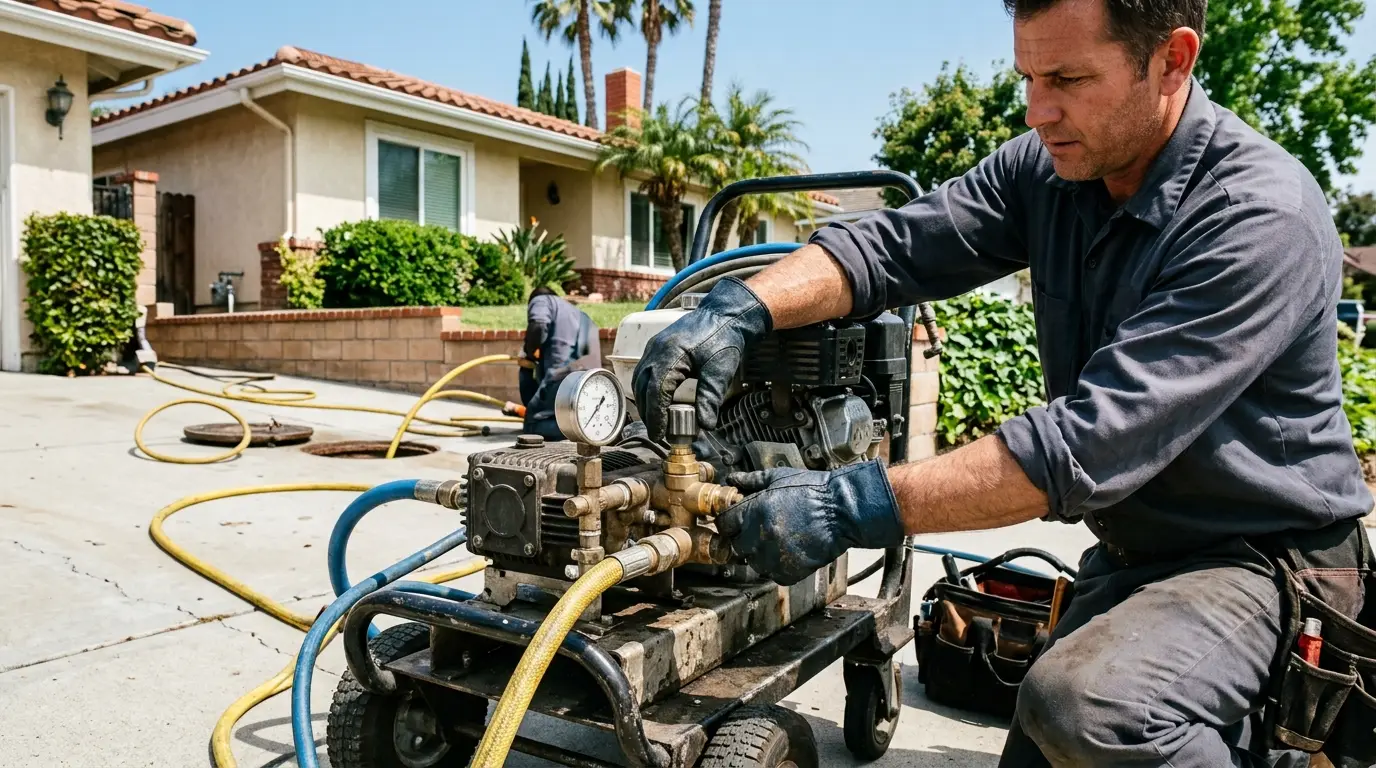
Cabling punches a hole through a blockage. Jetting removes it. High-pressure water scours grease, scale and root hair off the full bore of the pipe, after a camera confirms the pipe can take it.
How many times it has blocked this year is the question that decides it.
A drain cable is a mechanical tool. It bores through an obstruction and drags some of it back, which restores flow quickly and is the right first move for a hair mat or a paper blockage. What it does not do is clean the pipe. The grease, soap scale and mineral coating that narrowed the bore in the first place are still there, and the channel the cable made starts closing the day it is finished.
Hydro jetting works differently. A high-pressure hose is fed down the line with a nozzle that directs most of the water backwards, so the jets pull the hose forward and scour the pipe wall as they go, flushing debris back toward the access point. The result on a badly coated kitchen line is a pipe at its original diameter rather than a pipe with a hole through the middle of the build-up.
That is why jetting is the answer to recurrence. If a line blocks every few months, the pipe is not plugged, it is coated. Removing the coating changes the interval from months to years. Understanding that distinction is most of the value of this page.
Jetting is not the default for every blockage. These are the cases where it earns its cost.
If the line blocked once and it was a hair clog, save your money and cable it.
The camera comes first, we do not jet a pipe we have not seen.
Tustin has two very different drainage populations. Older neighbourhoods run cast iron inside the house and clay out to the street; both scale and both attract roots at joints. Newer developments run plastic, which does not corrode but happily collects grease on a long horizontal run with minimal fall.
Restaurants and food-service tenancies are their own category. Grease interceptors and kitchen lines here need scheduled jetting rather than reactive clearing, because a kitchen line that backs up during service is not a plumbing problem, it is a closed kitchen.
Cooled fat laminates onto pipe wall and traps starch and solids. The classic candidate: jetting takes the bore back to full diameter.
Decades of corrosion leave a rough, restricted bore that catches everything. Jetted at controlled pressure with a nozzle chosen for fragile pipe.
Fine root mass regrowing through joints. Jetting clears it more completely than a cutting head, though the entry point still needs addressing.
Bellied or under-sloped runs hold water and settle solids. Jetting flushes them out, but the camera decides whether the slope itself is the real problem.
Camera, plan, jet, camera again. The second camera pass is not optional, it is the proof.
We look before we jet. The camera tells us the material, the condition, where the build-up is and whether the pipe is sound enough to take pressure. A cracked or badly deteriorated line gets a repair conversation instead.
Pressure and nozzle are matched to pipe material, diameter and the type of build-up. Grease, scale and roots each want a different nozzle, and old cast iron wants restraint.
Usually an exterior cleanout, working downstream so debris flushes toward the sewer rather than back into the house. Fixtures get protected before anything runs.
High-volume flush to carry debris out, then a second camera pass down the cleaned line so you can see bare pipe instead of taking our word for it.
You get an honest recommendation: leave it alone, or come back in twelve or twenty-four months. Where the camera found a defect, we price the repair rather than sell you a jetting subscription.
Half-day for most residential laterals.
The honest comparison, including the cases where jetting is the wrong purchase.
Faster and cheaper. Restores flow through a discrete blockage. The correct choice for a first-time clog, a hair mat or an emergency backup where the priority is getting the house usable tonight.
Trade-off: Leaves the pipe coated, so a recurring problem stays recurring.
Removes build-up across the full bore and flushes it out. Changes the recurrence interval on grease and scale lines, and preps a pipe properly ahead of lining.
Trade-off: Higher cost, needs sound pipe, and needs a camera first.
For commercial kitchens and houses with a known chronic line, a planned pass on a set interval instead of emergency calls at the worst possible time.
Trade-off: An ongoing cost, justified only where the alternative is repeat failures.
When the camera shows a broken joint, an offset or a belly, cleaning treats the symptom. Spot repair, trenchless lining or replacement treats the cause.
Trade-off: The real fix, at real cost. We would rather you heard it than paid for jetting twice.
Jetting costs more than cabling, and on a single first-time blockage it is usually the wrong purchase. Where it pays is recurrence. Three cabling visits in eighteen months typically costs more than one camera-and-jet, and you end up with a coated pipe at the end of it instead of a clean one.
Commercial pricing works differently again, because the number that matters there is not the invoice but the cost of a kitchen closing mid-service. Scheduled off-hours passes are almost always cheaper than the reactive alternative.
Quoted on line length, access and what the camera shows.
Jetting is not for every pipe. Badly deteriorated cast iron, cracked clay and some older joints should not be jetted at full pressure. That is exactly why the camera goes in first.
It does not fix a broken pipe. If roots are entering at a fracture, jetting buys time. Ask to see the footage of the entry point before deciding what to spend.
Clear the access. Cleanout accessible, and the area near it clear. Jetting moves water and debris, so we will lay protection over anything nearby.
Ask for the footage. Before and after. You paid for a clean pipe; you should be able to see one.
The services either side of a jetting job.
Not when the pipe is sound and the pressure and nozzle are matched to it. It can damage a pipe that is already failing, badly tuberculated cast iron, cracked clay, or a joint that has separated. That is the reason a camera inspection comes first rather than as an upsell afterwards.
Cable a first-time blockage. Jet a line that keeps blocking. The dividing line is recurrence: if this is the second or third time on the same line in a year, the pipe is coated and cabling is buying you a few more months at a time.
Most residential laterals are a half-day including both camera passes. A long commercial run or heavily scaled cast iron can take longer. If the camera finds a defect partway, we stop and talk to you rather than pressing on.
A normal household kitchen line, rarely, only if it has a build-up history. A busy commercial kitchen is a different animal, and quarterly to twice-yearly is common depending on volume and how the grease interceptor is managed.
It removes the root mass inside the pipe far more thoroughly than a cutting head does, and flushes the debris out. It does not stop the tree. Roots return through the same defect, so the lasting fix is repairing or lining the entry point.
Often yes, at reduced pressure with a nozzle chosen for the job, and only after the camera shows enough wall thickness to be worth it. On heavily deteriorated iron we will recommend you spend the money on replacement or lining instead. Jetting a pipe that is nearly gone is not a service, it is a risk.
We will tell you when cabling is the smarter spend.
Camera first, jetted to bare pipe, camera again, and a straight answer about whether the pipe itself needs work.
(714) 598-4492The plumber we send gives you a firm price before work starts, and stands behind their own workmanship.