Galvanized steel
Internal corrosion narrows the bore, so flow drops for years before a perforation appears. Restriction and leak in the same pipe.
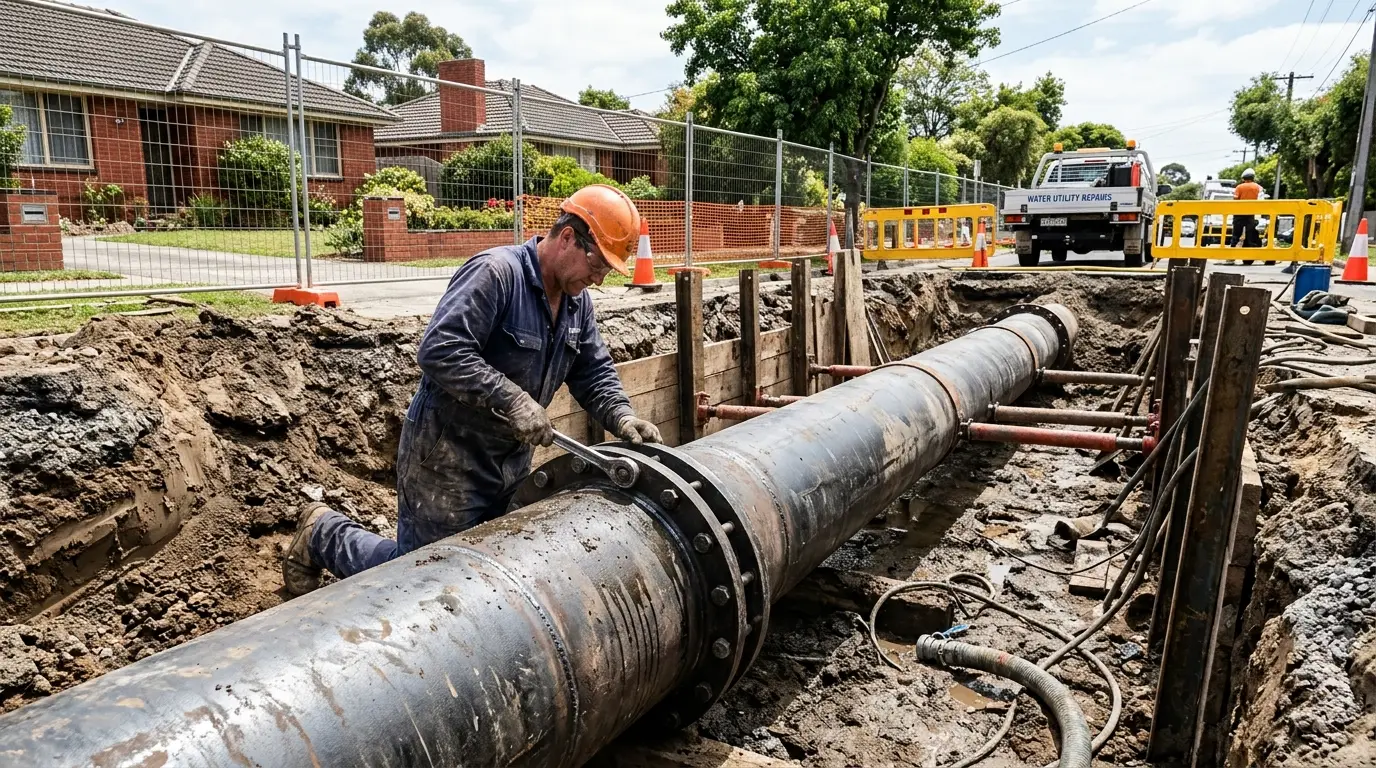
The service line between your meter and your house carries everything, and when it fails you get a wet parkway, a spinning meter and pressure that has quietly halved. Located, then repaired or replaced.
Water surfacing in the parkway? Mention it, that gets priority.
Your water service line runs from the city meter, usually in a box near the sidewalk, under the parkway and front yard, to the point where it enters the house. It is a single pipe with no redundancy. Everything downstream (every tap, the water heater, the irrigation, the fire-suppression on a commercial building) is fed through it.
Failures come in two flavours. Leaks announce themselves as a soggy parkway, a green stripe in dry grass, water weeping from a driveway joint, or a meter that keeps moving with the house shut down. Restrictions are quieter: pressure and flow drop as galvanized pipe corrodes internally, until two showers cannot run at once and nobody remembers when that started.
The complication is that low pressure has several possible causes, and only one of them is the service line. A failed pressure regulator, a partially closed valve, a clogged whole-house filter and a plugged aerator all present similarly. Testing sorts it out in twenty minutes, which is a great deal cheaper than digging up a yard on a hunch.
Leaks and restrictions look different. Both are worth a call.
A wet parkway with a spinning meter is a leak, not a sprinkler. Call it in.
Static pressure and flow rate tell us most of the story.
The material tells you most of what you need to know. Service lines from before roughly 1960 are typically galvanized steel, which corrodes from the inside until the bore narrows and the wall perforates. Sixties and seventies homes usually have copper, which lasts well but suffers in aggressive soil and at any point where it was bent, pinched or laid against concrete without a sleeve.
Then there is what happened above the pipe afterwards. Decades of driveway pours, irrigation trenching, hardscape and root growth mean many service lines have been loaded, nicked or crushed by later work. Add high static pressure in parts of the city, and the weakest point on a fifty-year-old line does not need much of an excuse.
Internal corrosion narrows the bore, so flow drops for years before a perforation appears. Restriction and leak in the same pipe.
Pitting from soil chemistry and from contact with concrete, worst at bends and where the line passes under hardscape.
Nicked by later trenching, crushed under a driveway pour, or displaced by root pressure. Fails long after the work that caused it.
A line adequate for a 1965 house is not adequate after a bathroom addition, a pool and modern fixtures. Pressure is fine; flow is not.
Test, locate, then dig, in that order and no other.
Static pressure at a hose bib, then flow under load. This separates a service line problem from a regulator, a valve or a fixture issue before anyone quotes excavation.
Shut the house side and watch the meter to confirm the loss is between meter and house. Then trace the line electronically and mark its route and depth on the surface.
A single mechanical failure on sound copper is a repair. A corroded galvanized line, or one that has already leaked twice, is a replacement, and we will say which we think it is and why.
Work in the parkway or near the meter involves the city and sometimes the water district. We handle permits and scheduling, including any required inspection.
New line laid at proper depth with correct bedding and sleeving, pressure tested, then the trench backfilled and compacted and the surface restored to what was agreed.
Most single-point repairs are a one-day job.
Four different answers, chosen on material, history and what is above the line.
Excavate at the located leak and replace a short section. Appropriate for mechanical damage to an otherwise healthy copper line.
Trade-off: Lowest cost, but on galvanized it is a patch on a pipe that is failing along its length.
A new line from meter to house, same path, at correct depth with proper sleeving. The standard answer for corroded galvanized.
Trade-off: Trenching the existing route, including whatever surface sits on it.
A new path that avoids a driveway, a mature tree or a section of hardscape, sometimes with a shorter or shallower run.
Trade-off: May use more pipe but far less restoration. Often the cheaper total.
Going up a diameter where the house has more fixtures than the original line was sized for, or where a remodel, ADU or pool is planned.
Trade-off: Marginal extra cost during a replacement, and much more expensive as a separate job later.
Length, depth and surface. Those three set the price. A short run across an open lawn is the low end; a long run under a paver driveway and a mature ficus is not. The pipe and fittings are a minor line item next to excavation and restoration.
If a replacement is on the table, this is the moment to think one step ahead. Upsizing during a replacement costs very little more, and putting in a new regulator and a proper house shutoff while the trench is open is far cheaper than revisiting either later.
Priced on length, depth and what sits above the route.
Static pressure. A hose bib gauge from any hardware store. Under 45 psi points at a restriction; over 80 points at the regulator. Either is useful to us.
The meter test. Everything off, read the meter, wait an hour, read again. Movement means a leak on your side of the meter.
Check the obvious first. A half-closed main valve or a clogged whole-house filter mimics a failing service line and costs nothing to rule out.
Know where your shutoff is. Meter box and the house-side valve. If the house valve does not work, replacing it during any main line work is a small add.
A failing main is usually found alongside pressure and leak symptoms. These are the related diagnoses.
Generally the water provider owns the main and the meter, and the property owner owns the service line from the meter to the house, including the section crossing the parkway. Confirm it for your address before agreeing to work; we will tell you what we understand the arrangement to be locally.
It might be, but check the regulator first. A failed regulator, a partially closed valve or a clogged filter all produce the same symptom for a fraction of the cost. A pressure and flow test at a hose bib sorts it out quickly, and that is where we start.
Sometimes. Directional boring and pulling a new line can avoid trenching a driveway, depending on depth, soil, length and other utilities in the way. It is assessed case by case, and where it works it saves a great deal of restoration.
For most residential replacements, part of one working day. We plan the changeover so the shutdown is a single window rather than repeated interruptions, and we tell you when it will be so you can plan around it.
If your house has gained fixtures since it was built, or you are planning a remodel, an ADU or a pool, yes, the incremental cost during a replacement is small and doing it separately later is not. We will tell you if your existing size is genuinely fine.
Restoration is scoped and priced up front as part of the quote, so you know what standard you are getting before work starts. Specialist finishes like stamped concrete or specific pavers may need a matching trade, and we will say so rather than discover it at the end.
Low pressure at every tap is usually the service line or the regulator.
Test first, locate second, dig only when we know where and why, plus a straight answer on repair versus replacement.
(714) 598-4492The plumber we send gives you a firm price before work starts, and stands behind their own workmanship.