Galvanized steel
Interior corrosion narrows the bore and eats the wall thickness. Threaded joints go first, usually where a horizontal run meets a riser.
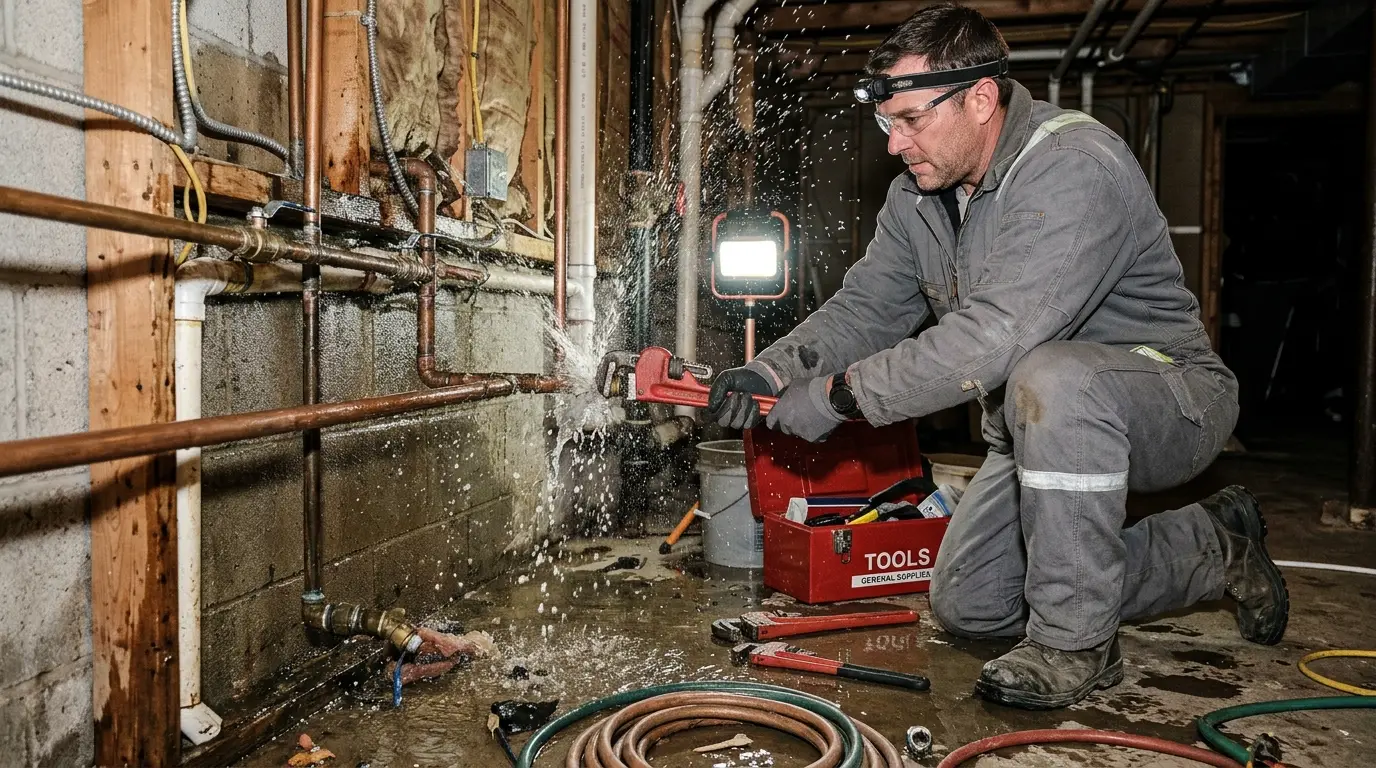
A supply line that has failed will keep pushing water into the building until someone closes a valve. The job is to isolate it, find the exact break, and repair the section properly rather than patching around it.
Not sure where your shutoff is? Call and we will talk you to it.
Most people expect a burst pipe to announce itself as a spray. In a Tustin house it is usually quieter than that: a hiss behind drywall, a stain that grows along a ceiling seam, a section of baseboard that has gone dark, or a water bill that jumped by a third with no change in habits. The pipe has split, and the water is travelling along framing and finding the lowest place to show itself.
The difference between a burst supply line and a drain leak matters. Supply lines are pressurised all the time, so they leak whether or not anyone is using water. Drain lines only leak when something upstream is running. If your wet spot grows overnight while the house is asleep, you are dealing with a pressurised line, and the volume is only limited by how long it takes someone to close a valve.
Breaks show up in three broad places. Inside walls and ceilings, where copper has thinned or a fitting has failed. Under the slab, where a line running through or beneath concrete has corroded. And outside, in the yard or parkway, where irrigation trenching, root pressure or a pinched fitting from an old renovation finally gives way.
Any two of these together is worth a call rather than a wait-and-see week.
If you can hear water and cannot see it, treat that as urgent.
Describe the sound and the wet spot, that usually narrows it before arrival.
Tustin housing stock spans roughly seventy years of plumbing practice, and each era fails in its own way. Add hard imported water and static pressure that runs high in parts of the city, and pipe walls thin from the inside long before anything visible happens outside.
Pressure is the quiet culprit. A regulator that has failed open lets street pressure through, and a line that would have lasted another decade at 60 psi starts finding its weakest fitting at 95. That is why a burst repair visit usually includes a pressure reading before anyone quotes the fix, repairing the split without addressing the cause just moves the next failure a few feet down the run.
Interior corrosion narrows the bore and eats the wall thickness. Threaded joints go first, usually where a horizontal run meets a riser.
Pinhole leaks from water chemistry and erosion at elbows where flow direction changes. One pinhole usually means others are forming.
Certain first-generation plastic fitting and manifold systems became brittle. Failures cluster at the fitting, not the tubing.
A line pinched by a joist hanger, a nail through a stud bay, or an unsupported run that vibrates. These fail years after the remodel.
Four stages, in this order. Skipping any of them is how repairs get reopened.
Main valve closed, or the branch isolated if that is enough to keep the rest of the house usable. If you have not found your shutoff yet, we will walk you to it while you are still on the phone.
Pressure test the run, then narrow it acoustically before opening anything. The point of locating properly is that we cut one access hole, not four exploratory ones.
The failed length comes out and a new section goes in with proper support and transition fittings. Where the pipe is at end of life, we say so and price both the repair and the reroute so you can choose.
Water back on, system pressurised and held, every affected fixture run, and static pressure checked at a hose bib. You get told what we found and what we would watch next.
Most single-break repairs are finished in one visit.
Which one is right depends on the pipe material, the number of previous leaks and where the line lives.
Cut out the failed length and splice in new pipe. Right for a single mechanical failure on otherwise sound pipe, a nail strike, one bad fitting, frost or impact damage.
Trade-off: Cheapest and fastest, but does nothing for the rest of a deteriorating run.
Abandon the buried or inaccessible section and run a new line through the attic, a wall cavity or overhead. Common where the break is under a slab or beneath a finished floor.
Trade-off: More material and drywall work, but takes the pipe out of the place it keeps failing.
Replace a whole branch (a bathroom group, the kitchen wet wall, the hot side of the house) rather than chasing individual leaks through the same pipe.
Trade-off: Larger job, but the cost per fixture drops sharply compared with three separate repairs.
When the pipe material itself is the problem, replacing everything ends the cycle. Usually the answer after the third leak in two years.
Trade-off: Highest upfront figure, lowest ongoing risk. Worth pricing before you approve leak number three.
The pipe and fittings are almost never the expensive part. Access is. A break in an accessible garage wall and a break under a tiled bathroom floor use the same length of copper and land in very different places on the invoice.
We quote before work starts, and if the correct fix turns out to be bigger than the symptom suggested, you get the new number and the reasoning before anything else is cut. Nobody enjoys finding out mid-job that a repair became a reroute, but finding out from the plumber rather than the invoice is the part that matters.
We will give you the normal range for the location you describe.
Close the main. Street-side box or garage wall, clockwise until it stops. If the valve will not turn, do not force it, tell us and we will bring gear for it.
Open the lowest tap. A ground-floor tub or outside hose bib drains standing water out of the pipes instead of into your ceiling.
Move what water ruins. Electronics, paper, rugs and anything on the floor below the leak. Photograph the damage before you mop, insurers ask.
Leave the ceiling alone. A bulging ceiling holds a lot of weight. Stay out from under it and let us drain it deliberately.
A burst line rarely arrives on its own. These are the calls that usually sit either side of it.
Burst supply lines are routed ahead of routine work, so a Tustin address is typically same-day and often within a couple of hours. The first thing on the call is getting your water off, that stops the damage clock regardless of arrival time.
You can, and sometimes that is the sensible financial choice. The risk is that the building stays wet. Trapped moisture inside a wall cavity in a climate like ours turns into a mould remediation job that costs more than the plumbing repair did. If you are going to wait, at least get the cavity opened and drying.
Usually yes, but the goal is one opening in the right place. That is why locating comes before cutting. We cut clean, square access rather than ragged holes, which makes patching cheaper for whoever closes it up.
We close access neatly and leave it ready for finish work. Full texture and paint matching is a finish trade, and we will tell you honestly whether a drywall finisher will do a better job of matching your ceiling than a plumber will.
Not on the first one. On thin-wall copper, though, the second and third pinholes in the same era of pipe are a pattern, not bad luck. When you get there we will price repiping alongside the repair so the comparison is in front of you rather than hypothetical.
Sudden accidental water damage is commonly covered while the failed pipe itself often is not, and slow long-term seepage is frequently excluded. Read your own policy or ask your carrier. We can provide a written description of what failed and what was done, which is what adjusters ask for.
A short call tells you whether this is a repair or a repipe conversation.
From split galvanized in Old Town to a failed fitting in a Tustin Ranch wet wall, the sequence is the same: isolate, locate, repair, test.
(714) 598-4492The plumber we send gives you a firm price before work starts, and stands behind their own workmanship.