Failed diaphragm
The usual failure, and it usually fails open. Full street pressure enters the house with nothing visibly broken.
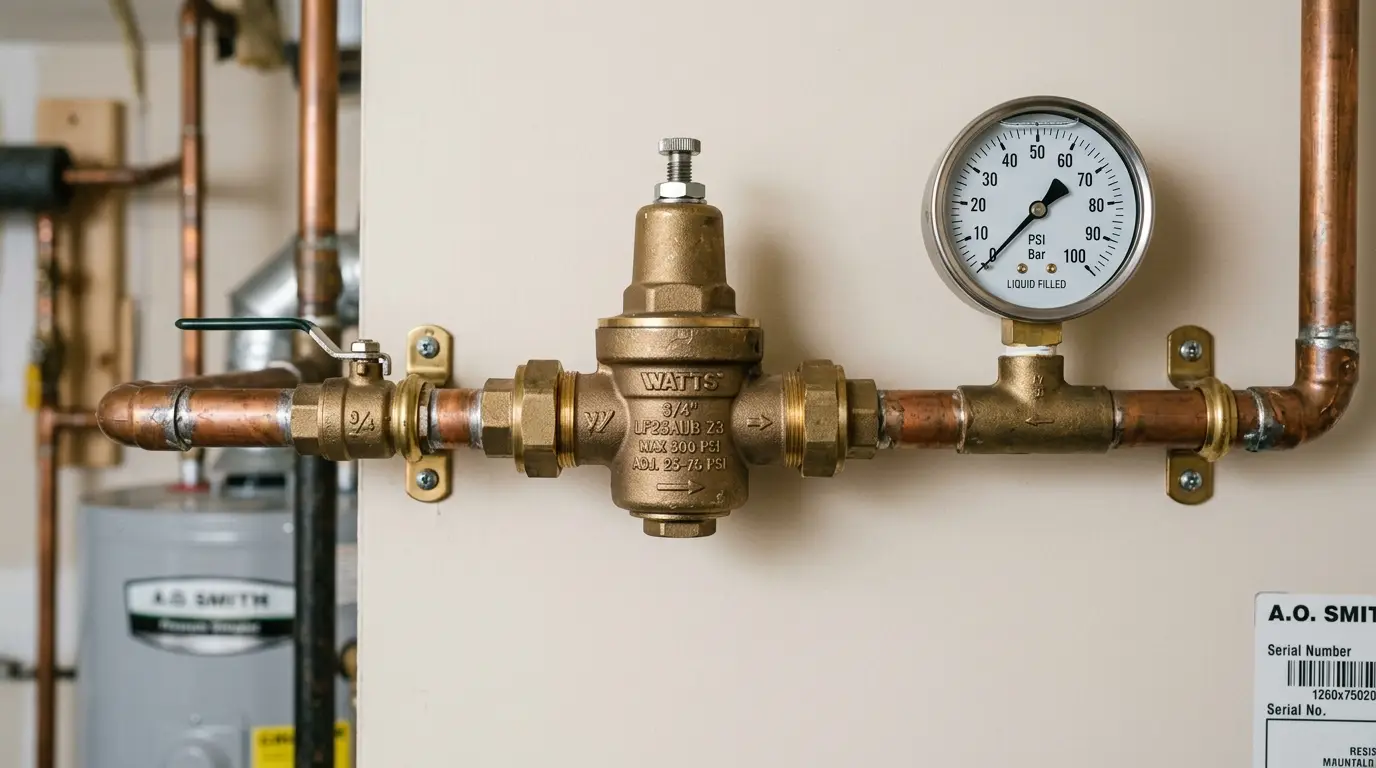
High static pressure quietly destroys fixtures, water heaters and pipe joints. A regulator is a small part that protects all of it, and when it fails, it usually fails open.
Banging pipes or a hissing toilet fill? Worth a reading.
Municipal supply pressure is set for distribution across a whole network, and that means it frequently arrives at a house higher than the house should run. A pressure reducing valve on the service line drops it to a working range (typically somewhere between 50 and 70 psi) and holds it there. Everything downstream is designed with that assumption.
Above about 80 psi, things start wearing out faster than they should. Fixture cartridges and seals fail early. Toilet fill valves hiss and weep. Water heaters trip their relief valve. Braided supply lines and hose connections are stressed constantly. Pipe joints and solder connections work harder, which matters a great deal on thin-wall copper that is already thinning from the inside.
The awkward part is that regulators usually fail open rather than closed. Nothing breaks, no alarm sounds, and full street pressure simply arrives in the house. Most people find out through a pattern of unrelated-looking failures over a couple of years: a leaking toilet, then a shower cartridge, then a supply line, then a pinhole.
Any two of these together and a gauge reading is worth taking.
Anything over about 80 psi is worth correcting. Over 100 is doing active damage.
Static and under-load readings in one short visit.
A regulator is a mechanical device with an internal diaphragm and spring. Hard water, sediment and years of constant duty wear it out, and the typical service life is often quoted at around ten to fifteen years. Plenty of homes here have their original one, decades past that, and a good number have none at all because one was never fitted.
The reason it matters more in this area is what it protects. Hard water and thin-wall copper are already working against your supply piping, and slab-embedded lines have no slack. High pressure accelerates every one of those failure modes. Correcting pressure is genuinely one of the cheapest things you can do to extend the life of a plumbing system.
The usual failure, and it usually fails open. Full street pressure enters the house with nothing visibly broken.
Grit and scale hold the valve off its seat or make regulation erratic, so pressure swings through the day.
Common on older properties. The house has run on street pressure its whole life, which explains a great deal of its repair history.
A regulator makes the system closed, so heated water has nowhere to expand. Without an expansion tank the relief valve becomes the pressure release.
Measure first. Everything else follows from the number.
A gauge on a hose bib with no water running, then a second reading with fixtures open. That gives us both the static number and how the system behaves under load.
Located, its age and condition checked, and its performance judged from the readings, held steady, drifting, or not regulating at all. If there is not one, that gets said plainly.
A closed system needs an expansion tank, and a missing or failed one is a common reason for a relief valve discharging. Checked and priced at the same time, because doing both together is much better value.
New regulator fitted with unions so it can be serviced in future, then adjusted to a sensible working pressure and confirmed on the gauge across several fixtures.
Fixtures run, water heater checked, and a final static reading taken. Hammering and hissing usually stop the same day.
Usually a same-visit job once tested.
These are separate items and you should see them separately.
Static and under-load readings, plus an assessment of the existing regulator and expansion control. Sometimes the answer is that everything is fine, which is a useful result.
Trade-off: A small cost to find out whether the rest is necessary. Worth doing before spending anything else.
A new pressure reducing valve, fitted with serviceable unions and set to a sensible working pressure. The main event, and usually a same-visit job.
Trade-off: Modest cost, immediate effect, and it protects everything downstream.
Thermal expansion control for a closed system, which stops the water heater relief valve doing the job instead.
Trade-off: A small addition, and much cheaper installed alongside regulator or heater work than as its own visit.
Where the house shutoff no longer seals (which is common) replacing it while the water is already off saves a separate job later.
Trade-off: Adds to today, saves considerably next time anything needs isolating.
This is one of the least expensive jobs on the site and one of the highest-value. A regulator replacement is a short visit and a modest part. Against that, high pressure shortens the life of a water heater, every fixture cartridge in the house, every supply connector, and your pipe joints.
If a regulator is being replaced, the sensible bundle is a regulator, an expansion tank if the system needs one, and a main shutoff if the existing one no longer seals. All three are cheap while the water is off and awkward as separate visits.
One of the cheapest preventive jobs on this site.
Buy a hose bib gauge. Inexpensive at any hardware store, and one of the most useful things a homeowner can own.
Read it with nothing running. That is static pressure. Under 50 is low, 50 to 70 is comfortable, over 80 needs attention, over 100 is doing damage.
Read it again at night. Municipal pressure often rises overnight when demand drops. A house that reads fine at noon can be well over 100 at 3am.
Tell us the number. If you have a reading, say so when you call. It shortens the diagnosis considerably.
Pressure problems create symptoms elsewhere in the house. These are the pages those symptoms lead to.
A comfortable working range for a home is roughly 50 to 70 psi. Below about 45 you notice weak showers, and above 80 you are shortening the life of fixtures, connectors and your water heater. Over 100 is doing real damage continuously.
Take a static reading at a hose bib. If it is well above 80, or if it drifts substantially between readings taken at different times of day, the regulator is not doing its job. Regulators usually fail open, so a high reading with nothing visibly broken is the classic sign.
No. Plenty of older properties in this city never had one fitted, and some have one that was removed or bypassed during past work. If a house has a history of small leaks and short-lived fixtures, this is one of the first things worth checking.
Frequently thermal expansion in a closed system with no expansion tank, sometimes combined with high incoming pressure. It is the safety device relieving pressure that has nowhere else to go. Fitting an expansion tank and correcting pressure solves it, capping the valve is dangerous.
Often, yes. Water hammer is commonly a high-pressure symptom, though it can also come from unsecured pipe runs or a fast-closing appliance valve. Correcting pressure is the first and cheapest thing to try, and it fixes it more often than not.
Commonly quoted at around ten to fifteen years, less in hard, sediment-heavy water. If yours is original to a house built decades ago, it is not doing what it was installed to do, whatever the gauge says on a good day.
If you own a gauge, tell us the number and we can say a lot.
One reading tells you whether the rest of your plumbing is being worn out by something a small part would fix.
(714) 598-4492The plumber we send gives you a firm price before work starts, and stands behind their own workmanship.