Scale in cartridges and aerators
Stiff handles and weak flow. Often cleanable, sometimes needing a cartridge, rarely needing a whole faucet.
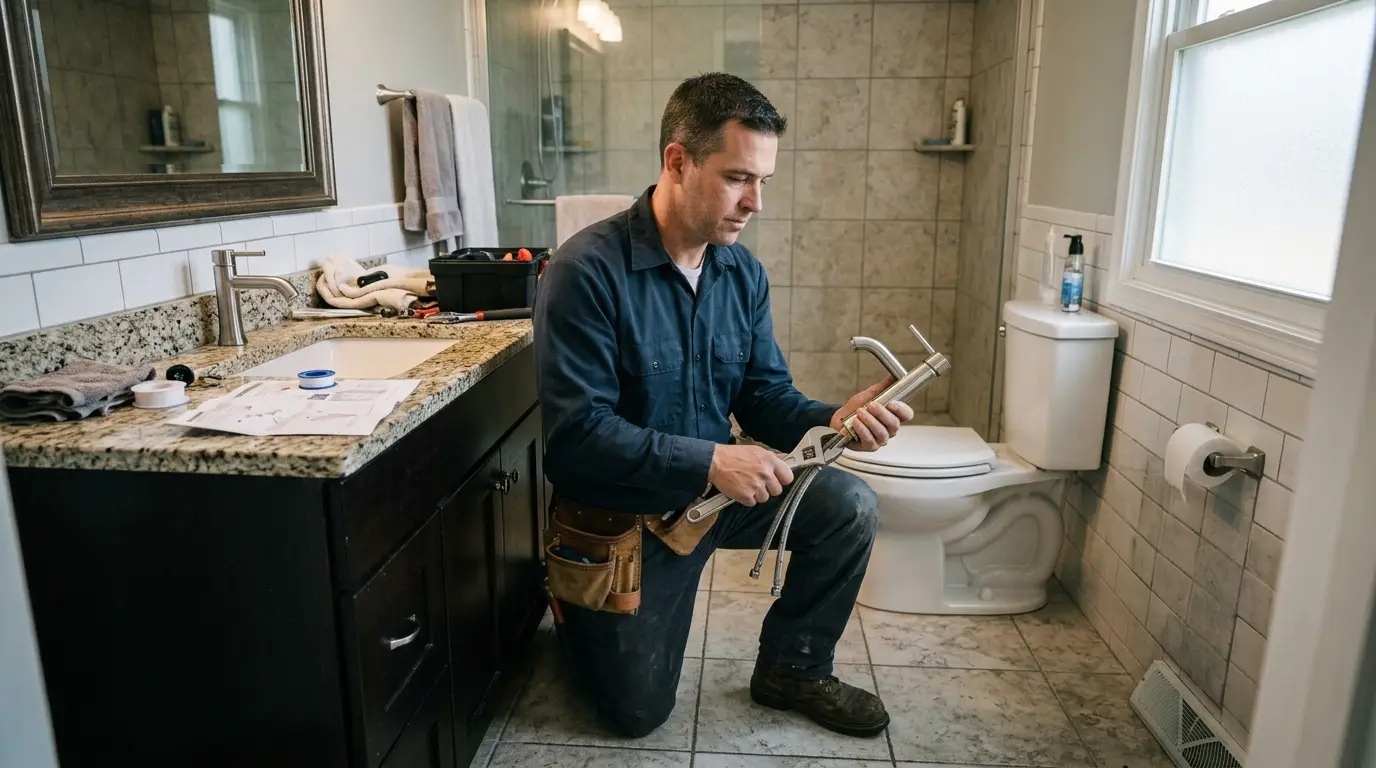
A faucet swap is simple until the shutoff will not close, the old nuts are seized and the supply lines are original. We plan for that, and replace the valves while we are under there.
Have the fixture already? Tell us the model and we will confirm fit.
Installing a faucet on a new sink in an open kitchen is genuinely easy. Replacing a thirty-year-old faucet in a cabinet with no room to work, over a disposal, with mounting nuts that have been wet since 1994, is a different task. The fixture is the same; the job is not.
The recurring obstacle is the angle stop, the small shutoff under the sink. On older installations these seize, or they close but do not seal, or they weep the moment they are moved. Discovering that after the faucet is off is how a thirty-minute job becomes an afternoon with the whole house water off. That is why we plan to replace them rather than hoping.
The other thing worth doing at the same time is the supply lines. Braided connectors have a service life, and a burst supply line under a sink is a genuinely destructive failure, often the cause of the kitchen floods people describe as coming from nowhere. Replacing them during a faucet install costs very little.
Failure, upgrade or compatibility. All three are routine.
If the shutoff under your sink does not close, that is worth fixing regardless of the faucet.
Most single-fixture swaps are a short visit.
Hard water again. Scale builds inside cartridges and aerators, so handles stiffen and flow drops long before anything breaks. A great many low-flow complaints are a clogged aerator that unscrews and cleans in five minutes, which is worth checking before buying anything.
High static pressure is the other factor. It shortens the life of cartridges, seats and seals across every fixture in the house, and it is why some homes need faucet repairs every few years while a similar house nearby does not. If fixtures keep failing, the pressure reading is the thing to check.
Stiff handles and weak flow. Often cleanable, sometimes needing a cartridge, rarely needing a whole faucet.
Cuts the life of every seal and cartridge in the house. Repeated fixture failures point at the regulator, not the fixtures.
Shutoffs that will not close or will not seal. The most common complication in any fixture swap on an older home.
Braided lines do not last forever, and a failure under a sink causes real damage. Cheap to replace during other work.
Short visits, but done properly rather than quickly.
Hole count and spacing, deck thickness, spout reach and height, drain configuration. Checked against the new fixture first, because a mismatch discovered after removal leaves you without a sink.
Shutoffs tested. Where they do not hold, they get replaced, and we would rather tell you that up front than fight a weeping valve behind your new faucet.
Old fixture out, old sealant and mineral residue cleaned off the sink or countertop so the new escutcheon seats and seals properly.
Fixture mounted and secured to the manufacturer specification, new supply lines, drain and trap components reassembled correctly with proper slope and no makeshift fittings.
Water on, every connection checked dry under pressure, hot and cold confirmed on the correct sides, drain run and aerator flow checked before we pack up.
Several fixtures in one visit costs less than several visits.
Kitchen, bath, laundry and outside. Common jobs and the trade-offs worth knowing.
Single-hole, three-hole and bridge configurations, pull-down sprayers, soap dispensers and filtered taps. Hole count and spacing are the constraint, and deck plates solve most mismatches.
Trade-off: Fewer holes is easy; going from one hole to three is not without a new sink or a deck plate.
Centreset, widespread and vessel faucets, plus drains and pop-up assemblies. Widespread sets need the right hole spacing, which is worth confirming before you buy.
Trade-off: Vessel and widespread installs take longer, and access under a small vanity is often the hardest part.
Pot fillers, bidet seats, instant hot taps, water-filter taps and laundry connections. Most need a new supply take-off and sometimes a power outlet.
Trade-off: The fixture is easy; the supply and power route is where the cost sits.
Replacing seized or leaking bibs, adding a new one, and fitting frost-resistant or anti-siphon types where required.
Trade-off: Straightforward on an accessible wall; more involved where the supply has to be extended.
Priced per fixture, with the usual variables being access and the state of what is already there. A vanity faucet in an accessible cabinet is at the low end. A kitchen faucet in a deep cabinet over a disposal, with seized angle stops and corroded mounting hardware, is at the high end.
Batching saves money. Four fixtures in one visit is meaningfully cheaper than four separate visits, because the setup, the water shutdown and the travel happen once. If you have a list, do the list.
Per fixture, with valve replacement priced separately.
Count the holes. One, three, or a widespread set, and measure the spacing centre to centre. This is the single most common cause of a returned faucet.
Measure the reach. Spout height and reach relative to your sink. A beautiful faucet that sprays over the back edge is a daily irritation.
Test your shutoffs. Try closing the valves under the sink. If they will not turn or will not seal, mention it when you book.
Clean the aerator first. If your complaint is weak flow, unscrew the aerator and rinse it. Sometimes that is the whole problem.
Fixture work rarely arrives alone, the valve, the supply and the drain underneath are all in reach on the same visit.
Yes, and most people do. Send us the model before the visit and we will confirm it fits your hole configuration and deck. Manufacturer warranty remains yours; we warrant the installation work.
Usually the aerator, either clogged with debris disturbed during installation or simply a low-flow model doing what it is designed to do. Sometimes a shutoff is not fully open, and occasionally a supply line is kinked. All quick to check.
Not always, but frequently on older installations. If a valve will not close fully or weeps when moved, replacing it is a small addition during work you are already having done, and it means the next repair does not require shutting off the whole house.
A cartridge or seat kit fixes most drips inexpensively, provided parts are available for that model. On a very old or unbranded faucet, parts often are not, and replacement becomes the practical answer. We will tell you which situation you are in.
Yes. Both need a new supply take-off, and a filtered or instant-hot tap usually needs an outlet under the sink as well. The fixture is the easy part; where the supply and power come from determines the scope, so we will look before quoting.
Several, and doing them together is much better value than booking them separately. Give us the list when you call and we will allocate the right amount of time rather than rushing the last one.
Hole count, spacing and depth decide what will work.
Fit checked before removal, new supplies and shutoffs, every connection tested under pressure.
(714) 598-4492The plumber we send gives you a firm price before work starts, and stands behind their own workmanship.