Dissolved calcium and magnesium
The cause of scale, spotting and poor lather. A softener is the only thing that genuinely addresses it.
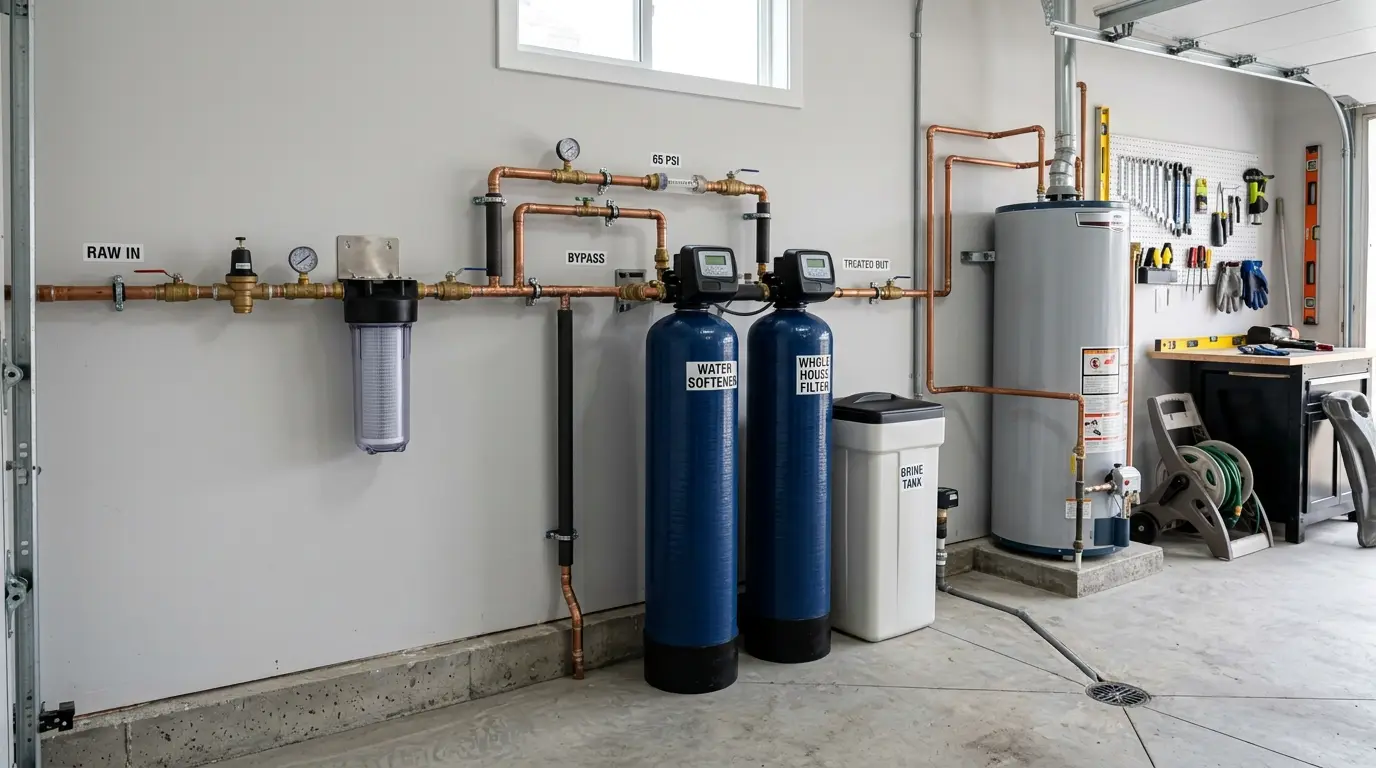
Scale on fixtures, spotting on glassware, short water heater life and soap that never lathers. Softening and filtration sized for the household, sited sensibly, with drain and bypass done properly.
Household size and number of bathrooms is enough to start sizing.
Southern California relies heavily on imported water, and it arrives mineral-rich. Those dissolved minerals are why glassware spots, why shower doors film over, why soap will not lather and why a kettle furs up. None of that is a plumbing fault. It is the water, and every house on your street has the same problem.
The expensive part happens where you cannot see it. Scale forms on the floor of your water heater, insulating the water from the burner so it runs longer and hotter, which shortens tank life and raises gas use. It coats heat exchangers in tankless units. It furs up fixture cartridges and aerators. Almost every recurring maintenance item in a local plumbing system traces back to it.
Softening and filtration are different jobs and worth separating. A softener exchanges hardness minerals for sodium or potassium, which addresses scale and lather. Filtration removes particulate, chlorine taste and odour, or specific contaminants, depending on the media. Wanting better-tasting drinking water and wanting less scale are two goals with two different answers.
Most local homes have several of these. That does not make them normal.
A hardness test costs almost nothing and tells you exactly what you are dealing with.
Hardness tested and the install location assessed.
Water in this part of Orange County is generally hard, with the exact figure varying by source blend and by season. That is why a hardness test at your address is worth more than a regional average, it sets the grain capacity a softener needs and therefore how often it regenerates.
It is also worth being clear about what treatment does not do. A softener does not remove chlorine taste, and it does not filter sediment or improve drinking water flavour much on its own. A carbon filter does that. A reverse osmosis unit at the kitchen sink goes further for drinking and cooking water. Sold correctly, these are complementary; sold badly, one gets pitched as all three.
The cause of scale, spotting and poor lather. A softener is the only thing that genuinely addresses it.
A taste and odour issue, not a hardness issue. Carbon filtration is the answer, not a softener.
Sediment from mains work or older service lines. A pre-filter protects both the softener and every fixture downstream.
Reverse osmosis under the sink for drinking and cooking, where the goal is quality at one tap rather than the whole house.
Test, size, site, install, commission. The siting decision is the one people underestimate.
Hardness measured at your tap, plus household size and fixture count. Those two numbers determine the grain capacity and how often the system will regenerate.
It needs to be on the main before the water heater, with a drain for regeneration, an outlet, and enough room for salt refilling. Garage walls are the usual answer; some homes need a plumbing loop added.
Regeneration discharge routed to an approved drain with the correct air gap, and a bypass fitted so the house has water if the unit is ever serviced or removed.
Unit set, connected into the main with unions for serviceability, bypass and shutoffs fitted, outside hose bibs left on hard water where that is preferred so you are not softening the garden.
Hardness set, regeneration scheduled, the first cycle run and checked, then a walkthrough of salt, settings and what to expect. Softened water feels different, and you should know that in advance.
Equipment, install, drain and bypass itemised.
Match the equipment to the actual complaint.
The standard and the only approach that genuinely removes hardness. Ends scale, restores lather, extends water heater and fixture life.
Trade-off: Needs salt refilling, a drain for regeneration, and adds a small amount of sodium to the water.
Removes chlorine taste and odour across the house, and protects a softener downstream. Often paired with a softener rather than chosen instead of one.
Trade-off: Does nothing for hardness. Media needs periodic replacement.
Salt-free conditioners that alter how minerals crystallise so they are less likely to adhere. No salt, no drain, no discharge.
Trade-off: Minerals remain in the water, so results are more modest than softening. Suits households that cannot accommodate a drain or prefer no salt.
Point-of-use filtration for drinking and cooking water, giving the highest quality at one tap without treating the whole house.
Trade-off: One tap only, needs an under-sink location and a drain connection, and produces some waste water.
Two numbers matter: installation and running cost. Installation depends on the equipment, whether a plumbing loop already exists, and how much work the drain and bypass need. A garage with an existing loop and a nearby drain is the straightforward case.
Running cost is salt, occasional media or filter replacement, and the water used during regeneration. Set against that is a longer water heater life, fewer fixture repairs and less descaling, particularly if you have a tankless unit, where scale is the main enemy. We will lay out both sides rather than only the appealing one.
Including running cost, which is the part people forget.
Name the problem first. Scale and lather means softening. Taste and odour means carbon. Drinking water quality means point-of-use. They are not interchangeable.
Get a hardness number. Cheap test strips are enough to start. Sizing without it is guesswork.
Check you have a drain. A softener needs one for regeneration. It is the most common reason a preferred location does not work.
Ask about running costs. Salt, media, water used regenerating. A quote that only shows the install price is half a quote.
Hardness shortens the life of heaters and fixtures, which is where these related pages come in.
For most households on this water, yes, the case is strongest if you have a tankless heater, have replaced fixtures repeatedly, or are tired of scale on everything. The benefits are longer equipment life and less maintenance rather than anything dramatic on day one.
Not particularly, and that surprises people. Softening addresses hardness, not taste. If taste and odour are your complaint, carbon filtration is the answer, and for drinking water specifically an under-sink reverse osmosis unit does more than either.
They do something (they change how minerals crystallise so less scale adheres) but they do not remove hardness, so results are more modest than a true softener. They suit households that cannot fit a drain or do not want salt, and we would rather set that expectation honestly than oversell them.
On the main line before the water heater, with a drain for regeneration, power, and room to add salt. Garages are the usual location. If your plumbing has no loop, one can generally be added, and that goes in the quote rather than appearing as a surprise.
It depends on hardness, household size and how the system is set. A correctly sized and configured unit regenerates only as needed, which uses noticeably less salt and water than an old timer-based one. We set it up on your actual usage at commissioning.
No. Softened water is not aggressive to plumbing in normal domestic use. What damages pipes locally is high pressure and, ironically, the scale that hard water leaves. Many people leave outside hose bibs on hard water simply to avoid softening the garden and using salt on it.
We will tell you which problems softening will not solve.
Tested, sized, sited with a proper drain and bypass, plus honest limits on what softening and filtration each do.
(714) 598-4492The plumber we send gives you a firm price before work starts, and stands behind their own workmanship.