Worn cartridges and seats
The most common repair by a wide margin. Fixed from the front, no tile touched, provided parts exist for the valve.
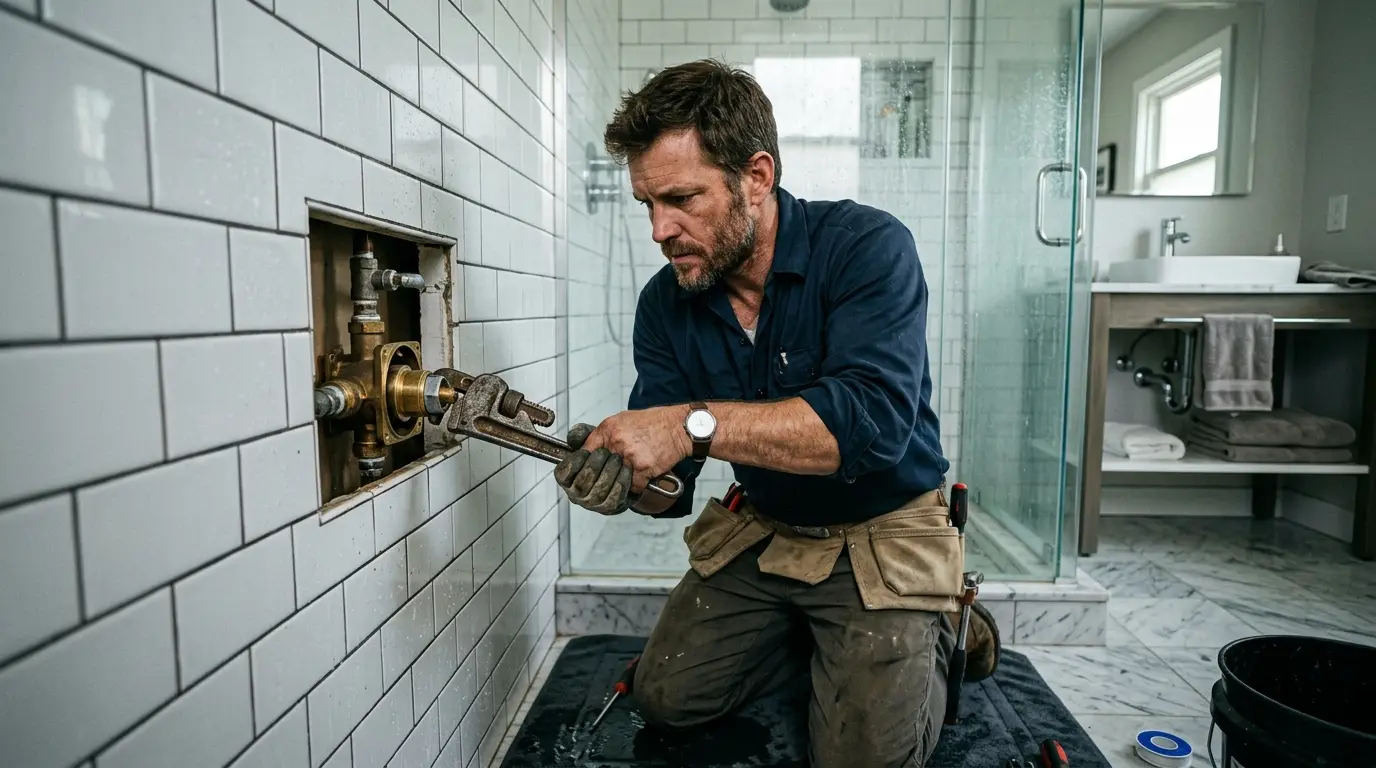
Dripping valves, handles that spin, water that will not switch to the shower head, and leaks that appear on the ceiling below. Fixed with the least tile disturbance the job allows.
Know your valve brand? It helps us bring the right cartridge.
Every plumbing component in a shower except the trim lives behind tile or a surround. That single fact governs the whole job. The plumbing itself is not complicated, a mixing valve, supply lines, a riser to the head, a tub spout drop, a drain and a trap. The skill is in doing what is needed with the smallest possible intervention in a finished wall.
The good news is that a large share of shower complaints are trim-side. A dripping shower is usually a worn cartridge, replaceable from the front with the handle off and no tile touched. Weak flow is often a clogged head or a restrictor. A diverter that will not hold is frequently a cartridge or a spout diverter, both accessible.
What genuinely needs access is a leaking valve body, a failed riser or drop, a shower pan leak, or a tub drain and overflow that has failed. Where there is a closet or a bedroom wall directly behind, cutting a neat access panel there is far better than removing tile. When there is not, we tell you what tile removal involves before starting rather than after.
Trim-side faults are cheap. Wall-side faults need a plan.
A ceiling stain under a shower is the one to call about promptly, that water has been travelling for a while.
Many drips are a cartridge, not a rebuild.
Cartridges and seals are consumables, and hard water plus high static pressure shortens their life considerably. That is the everyday failure. Older homes add a second category: original valve bodies from the fifties and sixties for which parts either no longer exist or no longer fit, which turns a cartridge job into a valve replacement.
Then there are the leaks that show up somewhere else. A shower pan that has failed at the corner or the drain connection, a solder joint at a riser, or a tub overflow gasket that has hardened. All three deposit water into the framing and show up on the ceiling below or at the base of the wall in the next room, which is why locating precedes cutting on any of these.
The most common repair by a wide margin. Fixed from the front, no tile touched, provided parts exist for the valve.
Parts no longer available or no longer matching. This is when a repair becomes a valve replacement with access work.
Failed pan corners, drain connections and tub overflow gaskets. Water goes into framing and appears in the room below.
Older valves let temperature swing when a toilet flushes. A pressure-balancing or thermostatic valve fixes it properly.
Identify, try the least invasive fix, then plan any access carefully.
Brand and series from the trim, so the right cartridge or rebuild kit is available. Where the valve is obsolete you will hear that early, because it changes the whole scope.
Cartridge, seats and springs, diverter, spout or head. Many complaints end here, with the tile untouched and the bathroom usable the same day.
Where the fault is behind the wall, the leak gets located and the access route planned, ideally through a closet or the back of an adjoining wall rather than through tile.
New valve body, riser, drop, drain or overflow as needed, properly supported and connected, with an anti-scald valve fitted where the old one had none.
Pressure tested, run hot and cold at full flow, drain checked, then trim reinstalled and any access panel closed neatly and left ready for finish work.
Most cartridge jobs are a single visit.
Most bathrooms need option one. Knowing the others exist stops you being sold them.
New cartridge, seats and springs, or a new diverter or spout. No tile removal, same-day, and the answer to most drips and stiff handles.
Trade-off: Depends on parts still being available for your valve series.
A new valve body where the old one is failed or obsolete, through an access panel behind the wall wherever the layout allows.
Trade-off: Requires an opening somewhere. Behind-wall access is far preferable to tile removal.
A modern anti-scald valve so temperature holds steady when another fixture runs. Worth doing whenever the valve is being replaced anyway.
Trade-off: Slightly more than a like-for-like valve, and a genuine daily improvement.
Tub drain and overflow replacement, shower drain reseating, or identifying a failed pan that needs the shower rebuilt.
Trade-off: A failed pan is a tiling project, not a plumbing repair, we will say so plainly.
The range is wide because the access is what costs, not the parts. A cartridge replacement is one of the more affordable repairs we do. A valve replacement through a clean access panel is moderate. A valve replacement requiring tile removal, or a failed pan, is a bathroom project involving other trades.
Ask for the access plan as part of any quote. Whether someone intends to come through the back of a closet or through your tile is the difference between a routine repair and a renovation, and it should be decided before work starts, not mid-job.
Cartridge, full valve or access work, all priced separately.
Photograph the trim. The handle and escutcheon usually identify the brand and series, which tells us which cartridge to bring.
Note when the drip happens. Constant, or only after use? Constant points at the valve; after-use is often just drain-down.
Check what is behind the wall. A closet or a bedroom wall directly behind the valve is good news for access. Have a look before we arrive.
Look at the ceiling below. Any stain, however faint, is worth mentioning. It changes the diagnosis from a drip to a leak.
Bathroom work sits next to valve, drain and pressure jobs more often than to anything else.
Usually, yes. Most drips are a worn cartridge or seat kit replaced from the front with the handle and escutcheon off. Tile only comes into it when the valve body itself has failed or is obsolete, and even then a behind-wall access panel is often possible.
Your valve has no pressure-balancing, so a sudden draw on the cold side changes the mix. Sometimes it is worsened by high static pressure or an undersized supply. A pressure-balancing or thermostatic valve fixes it properly, and it is the obvious upgrade if the valve is being replaced anyway.
Most likely a valve or riser leak, a failed shower pan, or a tub overflow gasket. All three send water into the framing where it travels before appearing. It needs locating rather than guessing, because the three repairs are very different in scope.
Then it is a valve replacement, which needs access. We will tell you that at the diagnosis stage rather than after opening anything, and we will plan the access route through the least destructive path available.
Almost always hair and soap in the trap or the first few feet of the branch, which clears easily. If several fixtures are slow together, or the tub gurgles when a toilet flushes, that is a bigger drain problem and gets looked at as one.
We do the plumbing and leave access neatly cut and ready. Tile removal, matching and setting is a tiling trade, and on a bathroom you care about, a tile setter will do a better job of it than a plumber. We will tell you honestly which parts we should and should not be doing.
Especially if water is showing up on a ceiling below.
Trim-side repair where it works, a planned access route where it does not, and a straight answer about which one you need.
(714) 598-4492The plumber we send gives you a firm price before work starts, and stands behind their own workmanship.