Water Pressure Regulator
Elevation makes regulation a working part, not a fit-and-forget one.
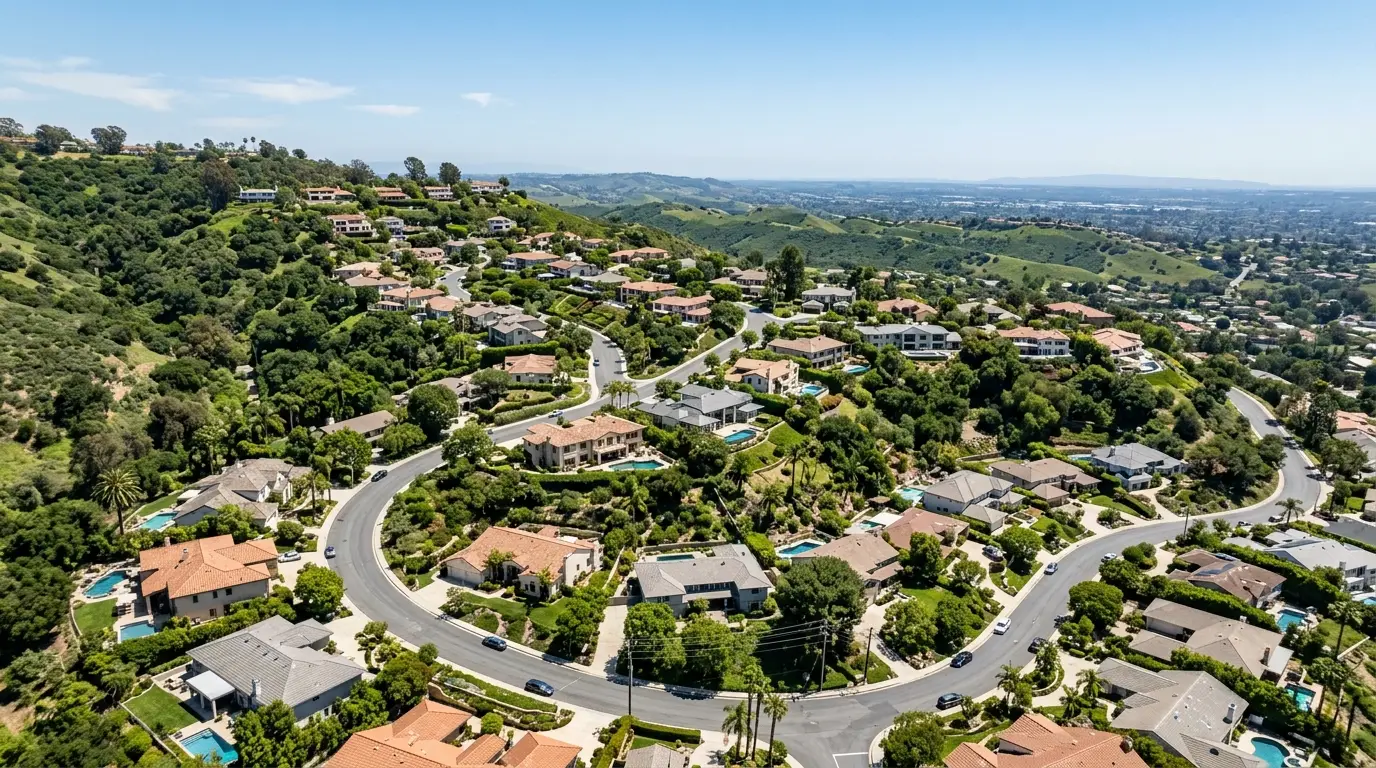
Lemon Heights sits above the flats, and elevation changes everything about how water gets in and how waste gets out. Pressure varies with height, laterals run downhill for long distances, and no two properties were built to the same plan.
Elevation and lot size shape the answer, mention both.
Every thirty-odd feet of elevation costs roughly a dozen psi of static pressure. On a hillside that is not a trivia point, it is the reason a property near the top can sit at the weak end of supply while one lower down needs serious regulation to protect its fixtures. Both are normal. Both need equipment that is actually working.
Waste is the other half. A long gravity lateral running down a slope generally drains well, which is an advantage, but slope also means settlement, and settlement means offsets and bellies at the points where the grade changes. Those are the spots that catch solids and eventually block, and they are rarely where you would guess.
Then there is the fact that these are custom homes. Manifold systems, multiple heaters, recirculation, sometimes legacy infrastructure from an earlier building on the site. The first job on an unfamiliar Lemon Heights property is understanding it, and we would rather spend that time up front than be surprised later.
On a slope, small ground movements produce plumbing symptoms years later.
On a hillside property, measuring beats assuming every time.
Where a property sits low in the zone, the regulator is doing real work every day and its condition matters. Where it sits high, a booster may be involved, and boosters have their own maintenance profile, waterlogged tanks, drifting pressure switches, and demand that has grown past the original sizing. Measuring across a full day, including irrigation, gives a far more useful picture than a single spot reading.
Long gravity runs across sloped ground fail at the grade transitions. A camera with a locator gives depth and position along the whole run, which on a hillside is the difference between one targeted excavation and several exploratory ones. Where the line has to be dealt with structurally, trenchless is often the only proportionate option given what surface restoration would cost on this terrain.
Many properties here have been extended, remodelled or partly rebuilt over decades, and the plumbing reflects that. Shutoffs in unexpected places, abandoned runs still connected, zones nobody can account for. Mapping it is a real service and the information stays useful for as long as you own the house.
On a slope, precision saves excavation you would otherwise pay to restore.
Infrastructure and diagnosis rather than fixture swaps.
Elevation makes regulation a working part, not a fit-and-forget one.
Locates grade-transition faults along long sloped runs.
Surface restoration on this terrain is the dominant cost otherwise.
Long private supply runs with elevation and ground movement.
Finds losses on runs too long and too buried to inspect by eye.
Custom builds age unevenly; some sections go long before others.
Lemon Heights is unincorporated, so permitting and inspection go through Orange County rather than the City of Tustin. That changes process and timelines on permitted work. We flag when something is likely to need a permit; we do not present ourselves as the authority on county requirements.
Access is the practical constraint here. Steep driveways, narrow private roads and long distances from the street to the work all affect what equipment can reach a job. Tell us about the approach when you call and we will send the right vehicle rather than discovering the problem on arrival.
Some properties share private roads with their own arrangements about heavy vehicles and working hours. If yours does, mention it, it occasionally decides when a job can happen.
One thorough visit produces information you will use for years.
Measure pressure at the highest and lowest fixture: the difference tells you more about your system than either number alone.
Watch downslope ground in dry weather: a supply leak on a hillside usually surfaces below the break, not above it.
Keep any locate report: on a long sloped lateral it is the most valuable document you can own.
The neighbouring unincorporated hillside communities.
Partly physics (every foot of height costs pressure) and partly system. On a hillside property with two or three storeys the difference can be substantial and entirely normal. It becomes a problem when the starting pressure is already low for the zone, at which point a booster or a regulator adjustment is the answer. Measuring at both ends tells you which situation you are in.
On sloped ground, yes, over long periods. Settlement produces offsets and low spots in a lateral, and those are where blockages start. It is slow (usually decades) and it is exactly why a camera along the full run is more informative here than anywhere else.
Not necessarily. Constant cycling is more often a waterlogged pressure tank, a switch out of adjustment, or household demand that has grown past the original sizing. All three are diagnosable in one visit, and none of them require replacing the pump as a first step.
Frequently, and this is where it earns its price, restoring a hillside after open trenching is expensive and sometimes involves more than landscaping. Whether your line is a candidate depends on its condition and continuity, which the camera establishes before anyone commits.
The process differs more than the substance. Unincorporated Lemon Heights goes through Orange County. Practically that affects timelines on permitted work. We will tell you when a job is likely to need a permit so you can plan, but we are not the authority on what the county will require.
Yes, and on a property that has been extended over decades it is worth doing as its own small job. We locate, label and note them for you. It makes every future call faster and it is genuinely useful in an emergency at two in the morning.
Steep or narrow approach? Tell us and we will send the right vehicle.
Elevation, long runs and one-off systems. Tell us the property and what it is doing.
(714) 598-4492A person answers, any hour, holidays included.